Behold the humble salt packet. Salt has been, at various times, used as a seasoning, a form of currency, a food preservative, and as a spiritual charm/talisman believed to bring good luck and to provide protection from evil spirits. Salt is a vital nutrient for our health: without it we simply cannot live. It is an essential element of our oceans, home to over two-thirds of the living creatures on this planet. And it has been culturally and economically instrumental throughout human history. Is there anything salt cannot do?
“The child learns to speak, not because it has learned teachers, but because it lives with those who know how to speak.”
– Lao Tzu
The great Taoist Master Lao Tzu was telling us not only how a child learns to speak, but he was also giving us a powerful metaphor for so many other things. The human being learns the Tao in this same way: not from great teachers, but from living among those who already know the Tao. This is also how each one of us learns how to truly live well: how to think, act, and speak with compassion and common sense, how to create things of value, how to find inner calm and peace, how to cultivate healthy relationships with others, how to live with enthusiasm and authenticity, and how to give and receive help and knowledge with an open heart. We learn these things from living among those who already know how to do them. And, perhaps most importantly of all, the human heart learns how to love and to be loved, in this manner, as well. We learn this by living in a family, in a community, and in a society that already understands how to do this. Once we realize this fact, it becomes incredibly clear why it is of such vital importance for each one of us to strive to preserve and cultivate these values in our own lives, in our own families, and in our own communities. We each form a vital link in the chain toward a better and more beautiful world.
“Elegance is often confused with superficiality, lack of depth. This is a serious mistake: human beings need to have elegance in their actions and in their posture because this word is synonymous with good taste, amiability, equilibrium, and harmony.”
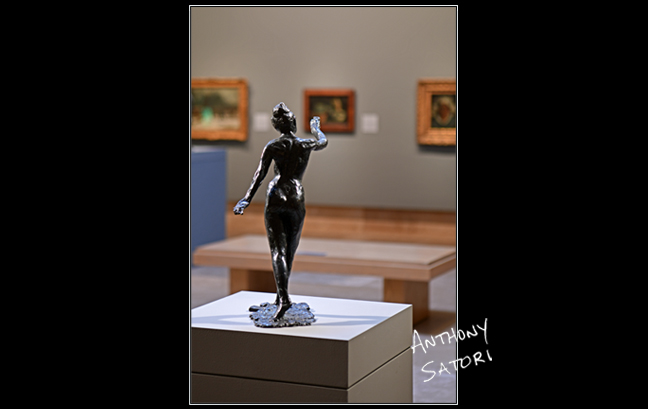
Edgar Degas was a French painter from the Impressionist Period of the late 1800s and early 1900s. He was known for his delicate, dream-like paintings of ballet dancers and, later in his career, for his highly sympathetic images of women in domestic roles. During his lifetime, Degas’ paintings were very well-regarded, and he achieved both critical acclaim and financial success. Through the century following his passing, his stature as a great artist only increased with time. What many people don’t realize, however, is that, in addition to being an accomplished painter, Degas also made sculptures; or, rather, he wanted to make sculptures.
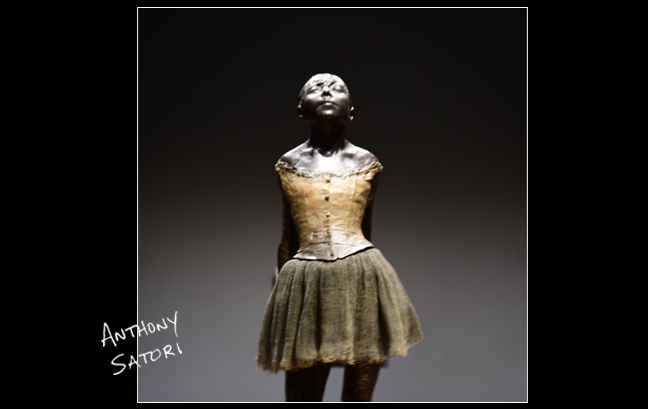
Degas, in fact, exhibited only one sculpture in his entire career: The Little Dancer of Fourteen Years (1881). It was a 1/3 life-size wax figure of a young girl striking a balletic pose, gazing upward with an enigmatic look on her face. She is wearing ballet shoes, a corset, and a skirt, with a white bow draped down her back. Upon its exhibition, it was so badly received by the public and by the critics, both for its “realism” and for its use of “unconventional” materials – including fabric-weaved tulle for the skirt, real human hair for the wig, and wax-coated ballet slippers on the feet – he took the piece down, brought it back to his studio, and never exhibited the artwork again. He was never to exhibit this sculpture – or any other sculptural work – for the remainder of his life. While he would continue over the next four decades to sculpt numerous figures in wax and clay in his studio – beautiful, graceful figures, mostly of women and horses – he never exhibited them publicly, and never cast even a single one of them in bronze.
Thankfully, after Degas passed away, his heirs discovered over 150 wax, clay, and plastiline sculptures in his studio, many of them still intact, and, within a couple of years, they enlisted Degas’ close friend and sculptor Albert Bartholomé to prepare over 70 of the best-preserved pieces for limited-edition bronze castings. Thus, the world was presented posthumously with an almost entirely never-before-seen body of sculptural artwork from an already world-famous painter, and the works have been shown and enjoyed throughout the world in museum collections ever since.
How poignant, to think that even an artist of such fame and renown as Edgar Degas could have been stung so badly by a single bad reception of a solitary piece of work that he never exhibited another sculpture in his lifetime. The world was almost kept from experiencing a complete “second” body of work from a quite wonderful artist, merely due to the callousness of a handful of critics. Thankfully, he had the pure desire and self-motivation to continue to create sculptural works for his own pleasure and edification, and, as a result, we have them to enjoy and appreciate today.
If you are curious to see what the infamous Little Dancer looks like, I have included my own photograph of it below. In terms of Degas’ sculptural career, this is the artwork that started (and almost ended) it all.
___________________
“Degas’ Little Dancer of Fourteen Years” | Anthony Satori
“They say that it’s an inexhaustible well. The thing that comforts me about it is the idea that all of this is from a singular Source. And that this Source is ultimately kind. And even though we may not understand the intentions of this Source, we are all connected and bound by it.”
“The Enigmatic Phenomenon of Clowns” | Anthony Satori
Clowns are such oddly polarizing figures. Some people love them, with deep affection. Others dislike them, with equal intensity. Many people are even afraid of them. But almost everyone has a strong reaction to clowns, one way or another.
Clowns are something of a paradox, as well, in that they deliberately hide their identities beneath layers of paint and outlandish costumes, and yet they lay themselves bare before us by means of their exaggerated gestures, movements, and facial expressions. They throw themselves wholeheartedly into absurd and even dangerous situations in an earnest attempt to make us laugh, gasp, and feel something. We root for them, we fear for them, and we sigh in relief when they escape unscathed.
Every move a clown makes is an effort to capture and hold our attention – to gain our sympathy, to draw our empathy – to be seen and understood by us. And in a way, this makes them a true mirror of the human condition. Perhaps this is why audiences react to clowns in such an intense manner. Maybe their antics hit closer to home than we realize, as we watch these strange, cartoonish figures performing exaggerated and unapologetic presentations of the human need to be seen and appreciated and loved.
And when they cry, it manifests in such an over-wrought caricature of emotion that it can often make us feel uncomfortable. The dissonance of their tears is heightened even further by being juxtaposed with such lighthearted and colorful facades. These are the axiomatic “tears of a clown.” They are expressions of sadness coming from a face with a painted-on smile, and we feel these tears in a uniquely poignant way. Maybe we see something of ourselves in this, as well: the act of wearing a face that says, “everything is alright,” while inside we may be feeling sad, lost, or even depressed.
Upon reflection, it seems that clowns may be a more apt representation of humanity than we might have ever imagined.
A “therianthrope” is a creature or entity which is part animal, part human. In some traditions, therianthropes are even thought to be able to move between their animal and human states fluidly, thus being capable of calling upon their heightened powers at will.
“Apotheosis” is the elevation of something or someone from a secular status to the level of a god. It can also mean when an object or a person achieves the culmination of their potential.
It is surely no coincidence that we often name our brands of automobile – some of our most powerful modern tools – after animals. From Jaguar to Pantera to Mustang, we identify these intensely personal and empowering machines with the names and images of some of the most natively powerful creatures that we can conjure, and then we drive them as if they were an extension of our own human selves. While driving, we very often come to identify completely with our vehicles, and by doing so, it is almost as if we are becoming like gods, or demi-gods, experiencing an elevation of our individual powers by extension. When we join with the spirit of a powerful animal in this way, to some degree we may be experiencing, somewhere deep in our psyche, even in our subconscious mind, something resembling a truly therianthropic apotheosis.
This concept becomes especially interesting when we consider how far back in history – even pre-history – the human race has been irresistibly drawn to the idea of therianthropy. Images and stories of part human/part animal entities – most often accompanied by a considerable elevation in prowess, even the attainment of god-like status – pervades the mythology of virtually every culture on earth. From the majestic centaurs of Greek mythology, to the alluring mermaids of ancient mariners, to the bird-gods of Native American cultures, to the formidable Minotaur destroying everyone who dared venture into his Athenian labyrinth (until he was finally killed by Theseus), hybrid human/animal creatures have populated our conceptual landscape for millennia. Even in our modern age, phantasms such as vampires and werewolves – with all of their attendant superhuman abilities – follow this same pattern.
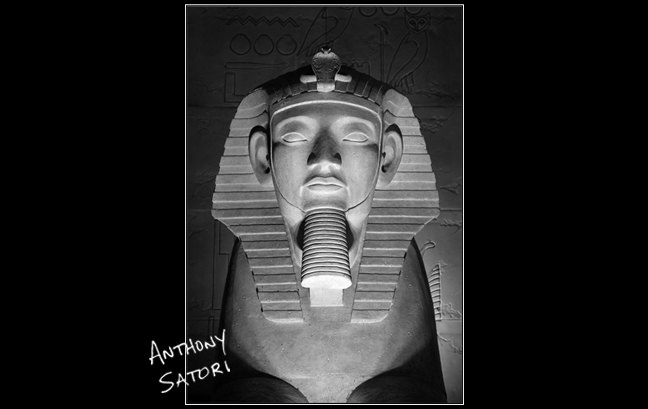
What is particularly striking, however, is the fact that therianthropic ideations date back even further than the ancient Greeks (circa 800 BC). Similar images stretch back a mind-boggling 5,000+ years to ancient Egypt, as exemplified by the god Anubis who had the body of a man and the head of a jackal, or the Sphinx which combines distinctly human features with powerful feline attributes.
Even more remarkable, therianthropic images reach even further back than this, upwards of an astounding 40,000+ years in the cave paintings of Europe. In fact, the very earliest of mankind’s visual expressions – that is, the very first subjects humans considered important enough to capture in representative artworks – portray a remarkably rich array of unmistakably therianthropic creatures, painted directly alongside entirely realistic representations of animals which lived at the time. From the very beginning, mankind has been depicting therianthropes, and such representations continue to show up, unabated, for the entirety of the thread of human artistic and mythological expression, all the way up to the present moment. It is clear that we have been dreaming of such metamorphoses – and the accompanying apotheoses – since the beginning of human imagination. Is it any wonder, then, that we would reach for such elevations in our use of modern technology? How could we not attempt to use our power of innovation to create extensions and elevations of our mortal being, when we have been imagining such hybrid existences since the beginning of time?
Or maybe – just maybe – such images were not mere figments of our imagination, at all, but were actually attempts to preserve a hazy and almost-forgotten past. Were the ancient cave painters perhaps actually depicting something real in their experience or recent memory? Does the veil of human pre-history hide a vastly more fantastic story of this planet than we could ever imagine? Did actual therianthropes roam the earth, and were these ancient depictions and mythologies actually realistic depictions of a world both fantastic and utterly familiar to these early artists and storytellers?
It is clear that deep echoes of such concepts resonate powerfully in our human minds. It is up to us to decide, then, in the face of such universality, if such ideations are purely products of our imagination, or if they are rather our collective consciousness trying to connect us with some deeper recollections of a mysterious, yet very real, past.
“Every time that someone has, with a pure heart, called upon Osiris, Dionysus, Buddha, the Tao, etc., the Son of God has answered them by sending the Holy Spirit. And the Holy Spirit has acted upon their soul, not by inciting them to abandon their religious tradition, but by bestowing upon them light.”





 Satori Circle | Art & Culture