“Meditation is to dive all the way within, beyond thought, to the source of thought and pure consciousness. It enlarges the container, every time you transcend. When you come out, you come out refreshed, filled with energy and enthusiasm for life.”
“And while I stood there, I saw more than I can tell and I understood more than I saw; for I was seeing in a sacred manner the shapes of all things in the spirit, and the shape of all shapes as they must live together like one being. And I saw that it was holy.”
“The ten thousand things are insufficient to distract the sage’s mind – that is the reason he is still. In the midst of darkness, he alone sees the dawn. In the midst of soundlessness, he alone hears harmony.”
Artists are not here to disturb the peace. Quite to the contrary, artists are here to point the way to something better, something higher. Artists are here to illuminate universal goodness, beauty, and truth. Artists are here to connect our minds and spirits by shining a light on shared human values, virtues, and meaning. To put it most succinctly, artists are here to elevate consciousness. And this, it seems to me, is quite the opposite of “disturbing the peace.”
It’s true, sometimes the expansion of consciousness can be disorienting in its exhilaration. It can have the side effect of shaking up the status quo, of waking us up from the hypnosis of complacency. But this is not the primary goal of art. It is not even its primary side effect. And if we mistake this secondary side effect for the actual purpose of art, we will miss it entirely. If we proceed under this misapprehension – especially if artists themselves engage in this folly – we will miss out on one of the most sacred and pure paths to enlightenment and enrichment that we, as humans, have available to us.
Other potential sources have failed us in this pursuit, time and time again. Religion, politics, media, education – each have failed us disastrously in this measure, at some point or another, often in what seems to be nothing less than orchestrated concert. And when we find ourselves in this state of affairs, art remains the last and best refuge of enlightenment. And when artists fail to live up to this ideal – when they fail to even recognize it – society suffers greatly.
.
“Humanistic scholars and artists used to be, and were supposed to be, as a group, carriers of and teachers of the eternal verities and the higher life. The goal of humanistic studies was… to inspire the student to the better life, to the higher life, to goodness and virtue. But in recent years and to this day, most humanistic scholars and artists have shared in the general collapse of all traditional values. And when these values collapse, there are no others readily available as replacements.”
“The sensation of ‘I’ as a lonely and isolated center of being is so powerful and common-sensical, and so fundamental to our modes of speech and thought… that we cannot help but experience selfhood except as something superficial in the scheme of the universe. I seem to be a brief light that flashes but once in all the aeons of time – a rare, complicated, and all-too-delicate organism on the fringe of biological evolution, where the wave of life bursts into individual, sparkling, and multi-colored drops that gleam for a moment only to vanish forever. Under such conditioning, it seems impossible and even absurd to realize that my ‘self’ does not reside in the drop alone, but in the whole surge of energy which ranges from the galaxies to the nuclear fields in my body. At this level of existence… my forms are infinite, and their comings and goings are simply the pulses or vibrations of a single and eternal flow of energy.”
“In dwelling, live close to the ground. In thinking, keep to the simple. In conflict, be fair and generous. In governing, don’t try to control. In work, do what you love. In family life, be completely present.”
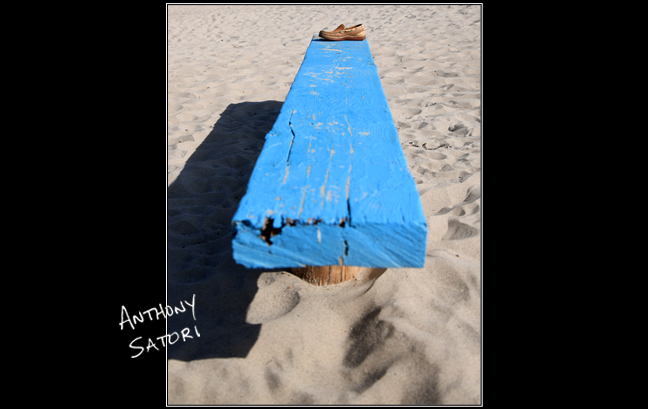
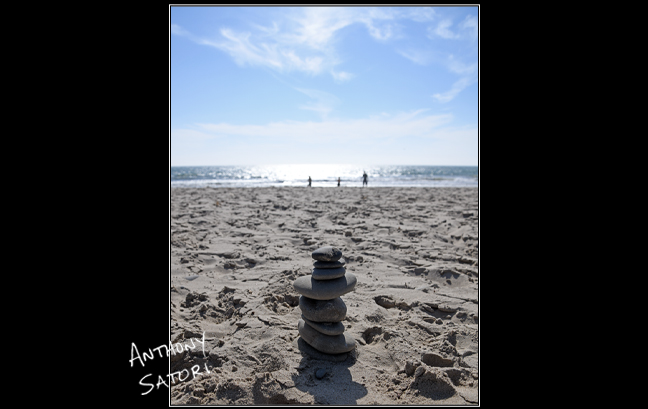
The thing about walking in sand is that you simply cannot rush. Each step takes time. Each step requires attention. You can choose a destination 10, 20, or even 100 feet away, but each step will only take you incrementally closer – slowly, deliberately – and you must make each stride mindfully and with care, so as to keep your balance and to keep yourself moving in the right direction. It is an exercise in patience. It is an exercise in presence. It is an exercise in Zen.
Sometimes you may think, “I will double my effort, triple it, maybe even multiply it five-fold.” But every such increase, even the most emphatic, tends to add at most maybe 5 or 10 percent to your speed – certainly not enough to be worth the additional expenditure of energy, not to mention the attendant elevation of stress, both physical and mental. Therefore, in the end, you eventually discover that your best strategy is merely to take it slow, to expend a reasonable amount of effort with each new step, and to move forward with calm, intention, and purpose – at the pace the sand will allow.
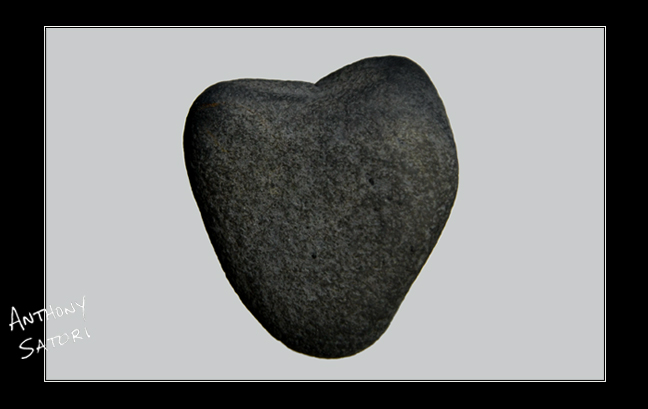
One of the delightful benefits, of course, of walking in sand in such a mindful manner is that sometimes you see things that you might have missed otherwise. Like a rock… shaped like a heart.

 Satori Circle | Art & Culture