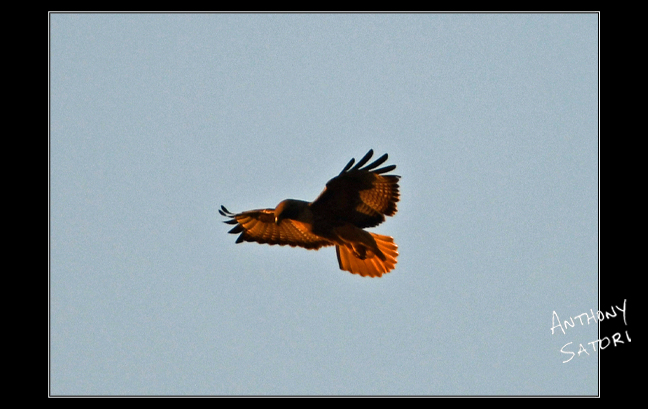
“Red-Tailed Hawk” | Anthony Satori
“Down through the ages, there has always been the spiritual path. It’s been passed on – it always will be – and if anybody ever wants it in any era, it’s always there.”
– George Harrison
“Red-Tailed Hawk” | Anthony Satori
“Down through the ages, there has always been the spiritual path. It’s been passed on – it always will be – and if anybody ever wants it in any era, it’s always there.”
– George Harrison
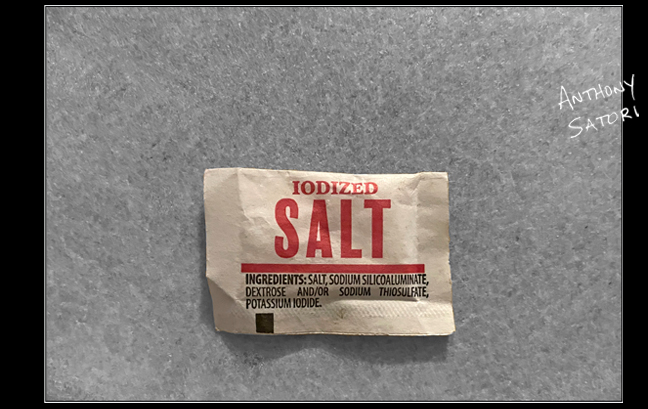
“Mystic Salt” | Anthony Satori
Behold the humble salt packet. Salt has been, at various times, used as a seasoning, a form of currency, a food preservative, and as a spiritual charm/talisman believed to bring good luck and to provide protection from evil spirits. Salt is a vital nutrient for our health: without it we simply cannot live. It is an essential element of our oceans, home to over two-thirds of the living creatures on this planet. And it has been culturally and economically instrumental throughout human history. Is there anything salt cannot do?

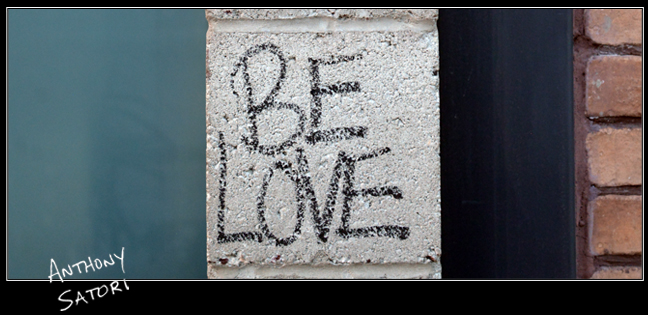
“Be Love” | Anthony Satori
“The child learns to speak, not because it has learned teachers, but because it lives with those who know how to speak.”
– Lao Tzu
The great Taoist Master Lao Tzu was telling us not only how a child learns to speak, but he was also giving us a powerful metaphor for so many other things. The human being learns the Tao in this same way: not from great teachers, but from living among those who already know the Tao. This is also how each one of us learns how to truly live well: how to think, act, and speak with compassion and common sense, how to create things of value, how to find inner calm and peace, how to cultivate healthy relationships with others, how to live with enthusiasm and authenticity, and how to give and receive help and knowledge with an open heart. We learn these things from living among those who already know how to do them. And, perhaps most importantly of all, the human heart learns how to love and to be loved, in this manner, as well. We learn this by living in a family, in a community, and in a society that already understands how to do this. Once we realize this fact, it becomes incredibly clear why it is of such vital importance for each one of us to strive to preserve and cultivate these values in our own lives, in our own families, and in our own communities. We each form a vital link in the chain toward a better and more beautiful world.
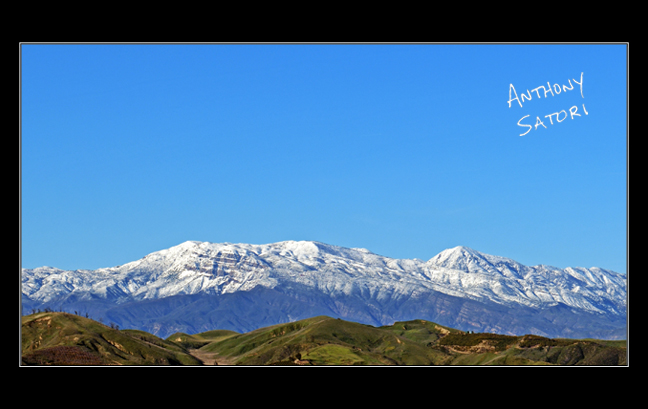
“Snowcapped” | Anthony Satori
“The highest praise of God consists in the denial of Him by the atheist who finds creation so perfect that it can dispense with a Creator.”
– Marcel Proust
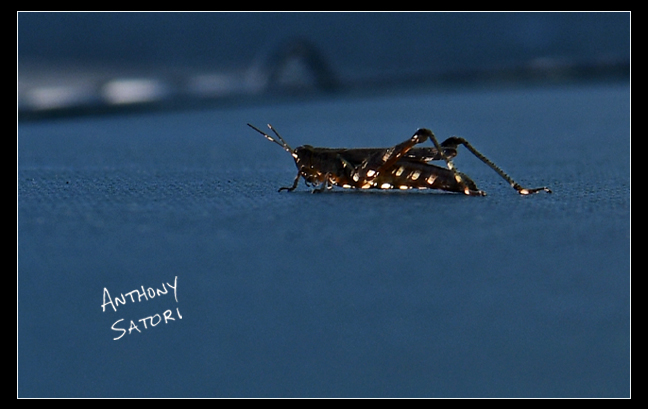
“Grasshopper” | Anthony Satori
“The invariable mark of wisdom is to see the miraculous in the common.”
– Ralph Waldo Emerson
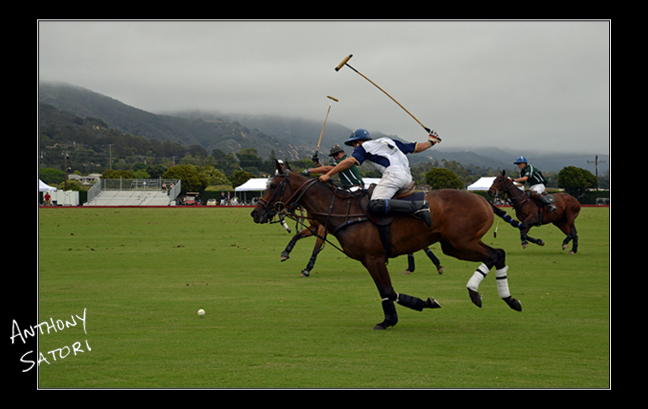
“Passion and Purpose” | Anthony Satori
“Our greatest glory is not in never failing, but in rising every time we fall.”
– Confucius
It is healthy to approach whatever you are doing, in any given moment, with all of your energy and attention. This is what it means to be dedicated, to be engaged, to live life with passion and purpose. Do your very best, every day, and bring your entire self to whatever experience you are having, big or small, with the most optimism and joy that you can muster. This is the single best way to get the most out of life.
And then, if at times you feel like the results of your efforts have somehow failed to live up to some preconceived standard or another, it is just as important to simply be able to let this go. Tomorrow is another day. None of us is perfect. None of us even comes close. And even on top of this, we all have moments, days, weeks, even months, when we struggle even harder than usual with one thing or another. It is important, especially during these times, to be patient and kind with oneself. Show yourself the same love that you would want to show someone that you care deeply about: the love of accepting and appreciating yourself exactly how you are, right now, in this moment. Strive to be encouraging and supportive of your own Being, and to feel true gratitude for everything good in this moment. Doing this for yourself is vital to your own emotional, spiritual, and even physical health.
And, quite wonderfully, making this a practice – a structural, habitual feature of your own internal monologue – also helps one to develop and cultivate the empathy and compassion that it takes to be patient and kind with others, and to love them just as they are, in the same way. The bottom line is this: You do not have to be perfect to be perfectly worthy of love.
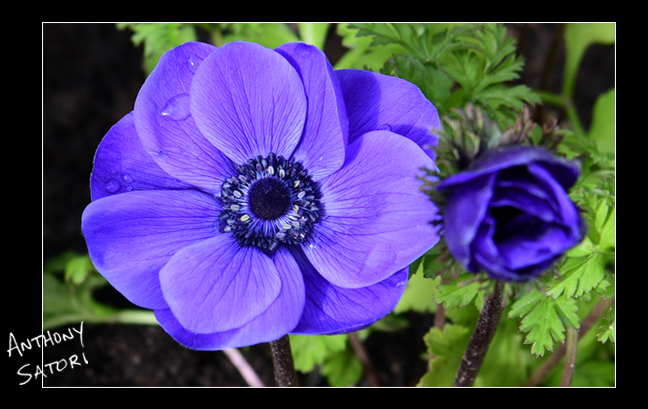
“Bloom” | Anthony Satori
“The Six Grandfathers have placed in this world many things, all of which should be happy. Every little thing is sent for something, and in that thing there should be happiness and the power to make happy. Like the grasses showing tender faces to each other, thus we should do, for this was the wish of the Grandfathers of the World.”
– Black Elk
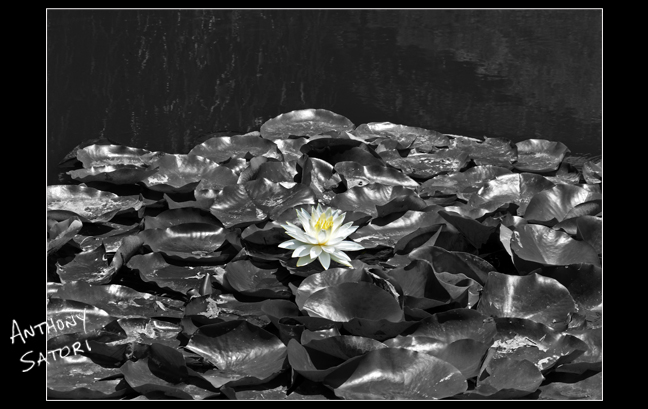
“Sacred Lotus” | Anthony Satori
“When the ground dissolves beneath me, I float.”
– Alan Watts
When I consider this statement by Watts, I place it in what I would call the “present eternal” tense. This is, of course, not an actual grammatical tense in any existing language, as far as I know. But for me, it holds a very special place in the lexicon. It is a way to say, “This is true, right now; but it is also true in a manner that transcends the limitations of time and space.” For example, when we tell someone that we love them, from the depth of our heart, I believe that we are speaking in the “present eternal” tense. This is because true Love exists outside of the limits of time and space. Similarly, when God told Moses that His name was, “I AM,” I believe He was indicating that He, in the same way, inhabits this transcendent, eternal realm.
Now, let us consider the sacred lotus. Its roots are sunk deeply into the earth, anchored firmly in the loamy mud at the bottom of a lake, pond, or slow-moving river. The lotus flower derives stability and nourishment from the depth of its roots, and yet its blossom lives far above this stratum, perched weightlessly and elegantly on top of the water. There it lives, peacefully aloft, supported by a bed of leaves, suspended effortlessly above all of the darkness, dirt, and tumult swirling below. When the ground dissolves beneath it, it floats. This is the lotus blossom’s sacred nature, now and always. It was created to live in the sunlight, to transcend the darkness of the water below, just like we are.
The lotus flower also has the rare ability – an ability usually reserved exclusively for animals – to produce its own heat. Consequently, it can regulate its own interior temperature and thereby moderate its own internal state of being in response to, even in direct contrast to, its environment. In addition to this, a dormant lotus seed can remain viable for hundreds of years, with some documented cases of dormant seeds over even 1000 years old re-awakening and successfully flowering. It doesn’t take much to see why this wondrous flower has been a source of fascination and inspiration – as well as a mystical symbol of transcendence and longevity – for artists, poets, and spiritualists alike.
So, the next time you feel stuck in the mud, exhausted by the murky tumult that swirls all around you, remember: you are a sacred lotus. When the ground dissolves beneath you, float. This is your sacred nature, now and always.
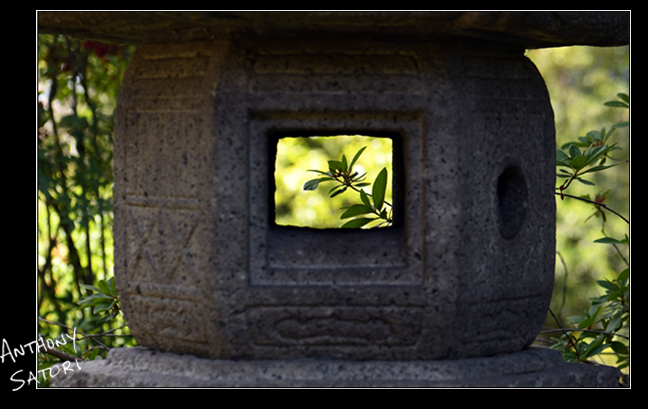
“Stone Lantern” | Anthony Satori
“Realize deeply that the present moment is all you ever have. Make the Now the primary focus of your life.”
– Eckhart Tolle
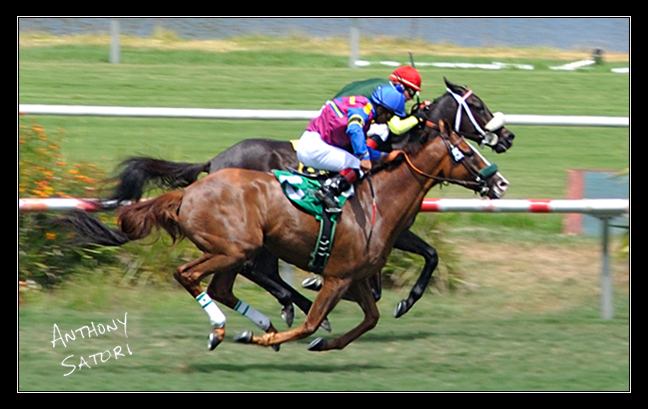
“A Day at the Races” | Anthony Satori
“I hadn’t played the horses in years and was bemused with all the new names. There was one horse called Big Pop that sent me into a temporary trance thinking of my father, who used to play the horses with me. I was just about to mention it to Old Bull Lee when he said, ‘Well I think I’ll try this Ebony Corsair here.’
Then I finally said it. ‘Big Pop reminds me of my father.’
He mused for just a second, his clear blue eyes fixed on mine hypnotically so that I couldn’t tell what he was thinking or where he was. Then he went over and bet on Ebony Corsair.
Big Pop won and paid fifty to one.
‘Damn!’ said Bull. ‘I should have known better, I’ve had experience with this before. Oh, when will we ever learn?’
‘What do you mean?’
‘Big Pop is what I mean. You had a vision, boy, a vision. Only damn fools pay no attention to visions. How do you know your father, who was an old horseplayer, just didn’t momentarily communicate to you that Big Pop was going to win the race? The name brought the feeling up in you, he took advantage of the name to communicate. That’s what I was thinking about when you mentioned it.’
In the car as we drove back to his old house he said, ‘Mankind will someday realize that we are actually in contact with the other world, whatever it is.’”
– Jack Kerouac
 Satori Circle | Art & Culture