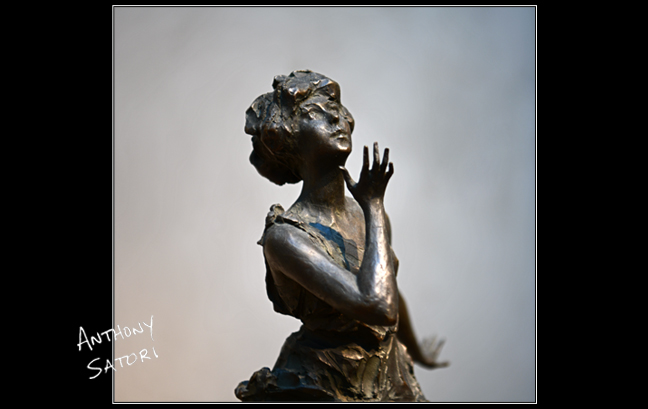
“Seek Light” | Anthony Satori
“You will find truth more quickly through delight than gravity. Let out a little more string on your kite.”
– Alan Cohen
“Seek Light” | Anthony Satori
“You will find truth more quickly through delight than gravity. Let out a little more string on your kite.”
– Alan Cohen
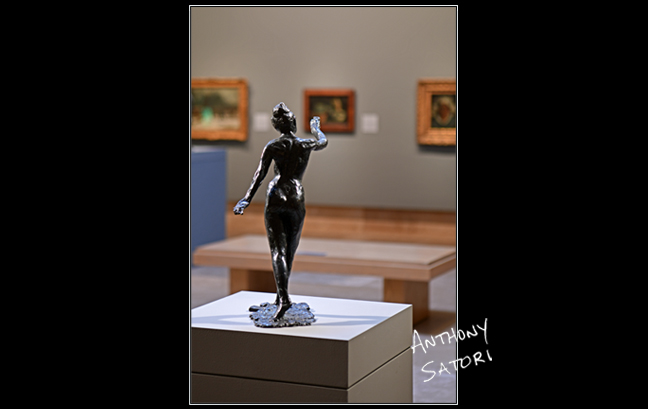
“Longing” | Anthony Satori
Edgar Degas was a French painter from the Impressionist Period of the late 1800s and early 1900s. He was known for his delicate, dream-like paintings of ballet dancers and, later in his career, for his highly sympathetic images of women in domestic roles. During his lifetime, Degas’ paintings were very well-regarded, and he achieved both critical acclaim and financial success. Through the century following his passing, his stature as a great artist only increased with time. What many people don’t realize, however, is that, in addition to being an accomplished painter, Degas also made sculptures; or, rather, he wanted to make sculptures.
Degas, in fact, exhibited only one sculpture in his entire career: The Little Dancer of Fourteen Years (1881). It was a 1/3 life-size wax figure of a young girl striking a balletic pose, gazing upward with an enigmatic look on her face. She is wearing ballet shoes, a corset, and a skirt, with a white bow draped down her back. Upon its exhibition, it was so badly received by the public and by the critics, both for its “realism” and for its use of “unconventional” materials – including fabric-weaved tulle for the skirt, real human hair for the wig, and wax-coated ballet slippers on the feet – he took the piece down, brought it back to his studio, and never exhibited the artwork again. He was never to exhibit this sculpture – or any other sculptural work – for the remainder of his life. While he would continue over the next four decades to sculpt numerous figures in wax and clay in his studio – beautiful, graceful figures, mostly of women and horses – he never exhibited them publicly, and never cast even a single one of them in bronze.
Thankfully, after Degas passed away, his heirs discovered over 150 wax, clay, and plastiline sculptures in his studio, many of them still intact, and, within a couple of years, they enlisted Degas’ close friend and sculptor Albert Bartholomé to prepare over 70 of the best-preserved pieces for limited-edition bronze castings. Thus, the world was presented posthumously with an almost entirely never-before-seen body of sculptural artwork from an already world-famous painter, and the works have been shown and enjoyed throughout the world in museum collections ever since.
How poignant, to think that even an artist of such fame and renown as Edgar Degas could have been stung so badly by a single bad reception of a solitary piece of work that he never exhibited another sculpture in his lifetime. The world was almost kept from experiencing a complete “second” body of work from a quite wonderful artist, merely due to the callousness of a handful of critics. Thankfully, he had the pure desire and self-motivation to continue to create sculptural works for his own pleasure and edification, and, as a result, we have them to enjoy and appreciate today.
If you are curious to see what the infamous Little Dancer looks like, I have included my own photograph of it below. In terms of Degas’ sculptural career, this is the artwork that started (and almost ended) it all.

___________________
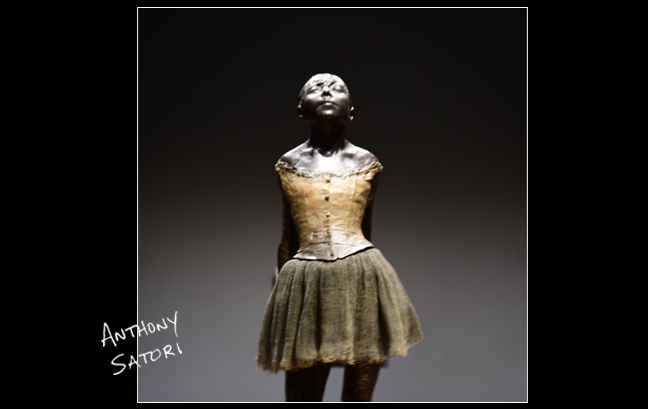
“Degas’ Little Dancer of Fourteen Years” | Anthony Satori
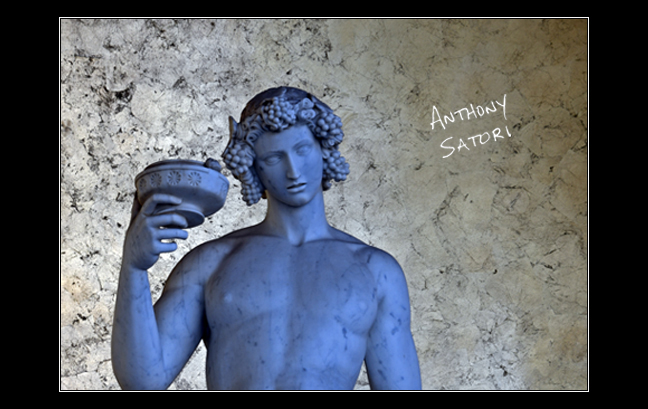
“Dionysus” | Anthony Satori
“Every time that someone has, with a pure heart, called upon Osiris, Dionysus, Buddha, the Tao, etc., the Son of God has answered them by sending the Holy Spirit. And the Holy Spirit has acted upon their soul, not by inciting them to abandon their religious tradition, but by bestowing upon them light.”
– Simone Weil
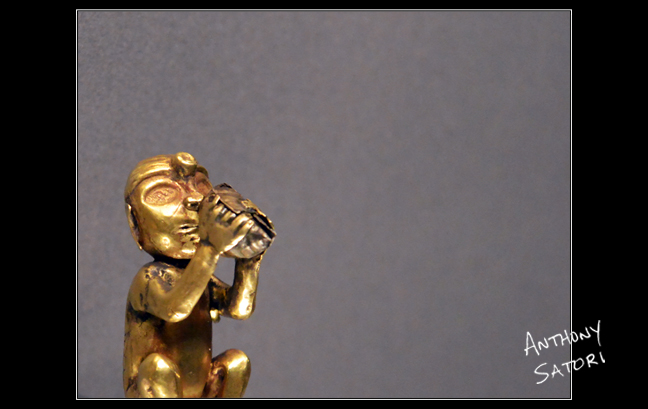
“Golden Conch Shell” –|– Anthony Satori
“Music has always been a matter of Energy to me, a question of Fuel. Some people call it Inspiration, but what they really mean is Fuel. I have always needed Fuel. I am a serious consumer. On some nights I still believe that a car with the gas needle on empty can run about fifty more miles if you have the right music playing very loudly on the radio.”
— Hunter S. Thompson
The music of the conch shell, for many cultures, has for millennia been the means for calling together the community for celebration, ritual, or a collective endeavor of some kind. For other cultures, it has represented a musical entreaty to communicate with the supernatural world. And for other cultures still, the conch produces nothing less than the sound from which the very universe was created.

“Silver Rabbit and Blue Dog” | Anthony Satori
“Always the beautiful answer who asks a more beautiful question.”
— e. e. cummings
Seek beauty, and the universe will show you beauty. Seek goodness, and the universe will surround you with goodness. Strive for knowledge and wisdom, and the universe will reveal its mysteries to you. Strive to be a source of kindness and joy, and the universe will enfold you in wonder.
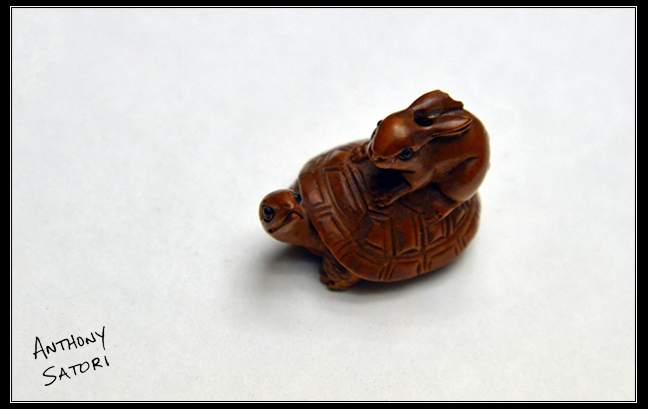
“The Tortoise and the Hare, Revisited” | Anthony Satori
“Truly to sing, that is a different breath.”
— Rilke
The breath used in singing does indeed seem to be a different breath, by its very nature. It shares its essence, it seems to me, with yoga breathing (pranayama), embodying the same kind of mind-body connection that this spiritual practice aspires to attain. It is the breath of life, of love, and of connection. It is a breath that holds a deeper creative resonance, as referred to in the ancient scriptures and mystic texts. It is a breath that comes not just from the body, but from the heart, from the soul, and from the spirit.
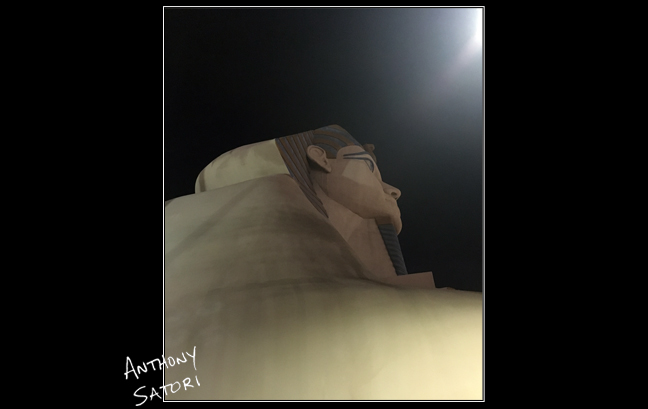
“Sphinx” | Anthony Satori
There have been countless attempts throughout history to decipher, represent, and/or access the spiritual world. Such efforts usually take the form of religion, philosophy, ritual, or artwork, and they are almost always fueled by our innate human drive to discover and/or create a door between the known world and that which exists beyond. As can be expected, every door that has been created by man up until now has been, by necessity, inherently flawed. The simple fact is that it is almost impossible to escape the corrupting influence of human imperfection, especially over time. But the destination is true. That which lies on the other side of the veil is real. It is pure, it is powerful, and it is eminently worth pursuing. So keep trying. Keep seeking. Every genuine attempt to expand our understanding of — and our connection with — the compassionate creative Spirit which pervades the universe is a gift to the future of the collective human soul.
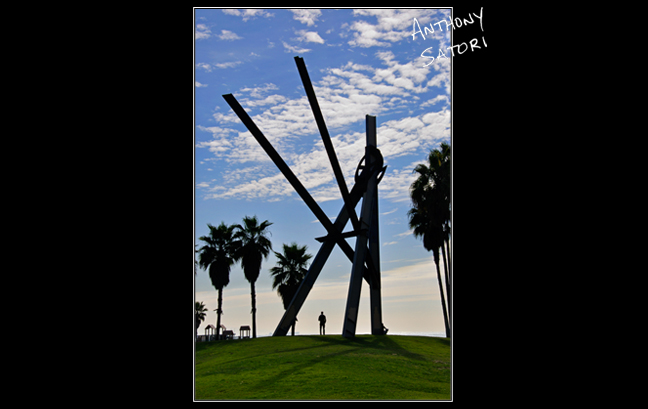
“Legacy” | Anthony Satori
“Everyone must leave something in the room or left behind when he dies, my grandfather said. A child or a book or a painting or a house or a wall built or a pair of shoes made. Or a garden planted. Something your hand touched some way so that your soul has somewhere to go when you die, and when people look at that tree or that flower you planted, you’re there.”
— Ray Bradbury
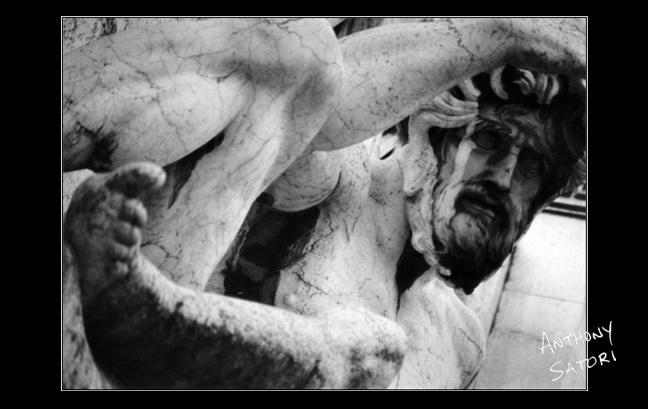
“Neptune in Repose” | Anthony Satori
Neptune is the Roman equivalent to the Greek god Poseidon. He is widely recognized as the god of the sea, standing strong and regal with his trident, heavily bearded and boldly postured, exerting great power over his underwater domain. His realm extends beyond the ocean floor, as well, since, as the ruler of water and climate, he is also the god of storms, wind and rain. He can provide safe passage to sea-faring vessels, or, just as quickly, he can bring them to their doom. He is also the provider of life-giving rainfall to agricultural endeavors, the filler of rivers and lakes with fish, and the one who causes underground springs to overflow with fresh drinking water.
Surely a deity of such breadth and reach deserves his own festival. And, as it happens, tomorrow, July 23, marks the ancient Roman festival of Neptunalia. Placed squarely in the heart of the dry season, this pleasant social event was slated as a time to celebrate the god Neptune and to implore him to bring more life-giving rain. Often, a bull would be sacrificed as a symbol of agricultural fertility, and then the people would celebrate with the traditional activities of having a feast in the shade of shelters built with tree branches, drinking spring water, and sharing a pleasant, joyful time with friends. During this festival, many of the standard social restrictions were lifted, giving people the opportunity to interact with others that they might not usually have the chance to meet. What better time to get together with friends, share a meal, and perhaps open yourself up to the possibility of meeting someone new?
Neptunalia is also a good time to reconsider our own relationship with water, both literally and symbolically. Many ancient religions place great importance on the metaphorical lessons that can be learned from water’s unique combination of fluidity, quiet patience, and immense power. “Nothing is softer or more flexible than water, yet nothing can resist it.” (Lao Tzu) There is much that we can learn from observing water, such as how to adapt to our environment while staying true to our core selves, going with the flow instead of fighting it, and finding creative solutions to challenges.
So, in celebration of Neptunalia, I encourage you to get together with some friends, share a feast, raise a glass of water, and open your mind to the flow of the Universe. You might be pleasantly surprised where it takes you!

 Satori Circle | Art & Culture