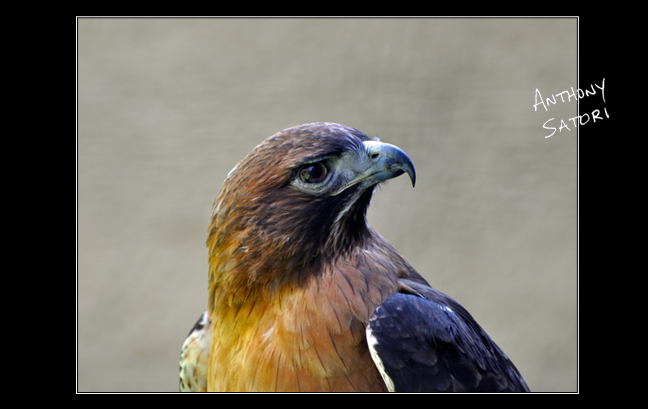
“Untranslatable” | Anthony Satori
“The spotted hawk swoops by and accuses me, he complains of my gab and my loitering. I too am not a bit tamed, I too am untranslatable, I sound my barbaric yawp over the roofs of the world.”
— Walt Whitman
“Untranslatable” | Anthony Satori
“The spotted hawk swoops by and accuses me, he complains of my gab and my loitering. I too am not a bit tamed, I too am untranslatable, I sound my barbaric yawp over the roofs of the world.”
— Walt Whitman
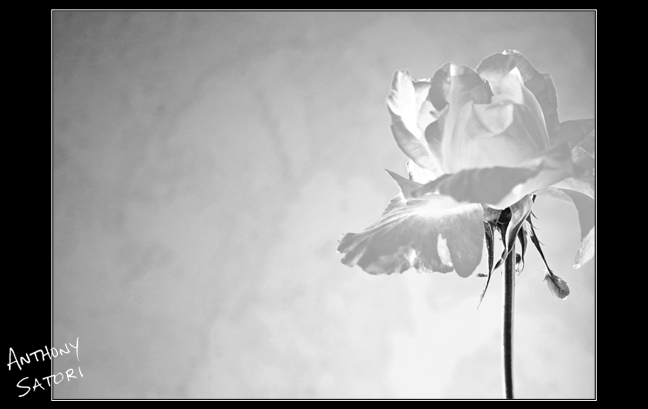
“La Vie En Rose” | Anthony Satori
“The richness of the world is always available to the poet.”
— Goethe

“Who’s That Little Mouse?” | Anthony Satori
(Me up at does)
— a poem by E. E. Cummings
“Me up at does
out of the floor
quietly Stare
a poisoned mouse
still who alive
is asking What
have i done that
You wouldn’t have”
Although quite poignant, I’ve always appreciated this poem by E. E. Cummings. I think it is a fine example of his remarkable economy of language, his touching sense of empathy, and his unmistakable signature style: a seemingly mixed-up, punctuation-free stagger of words which, upon closer inspection, actually turns out to be a carefully constructed poetic flow of thoughts and ideas. Like a lot of great art, Cummings’ poetry isn’t spoon-fed to the viewer. It requires effort and attention. But, in the end, it is always worth the journey.
Quite fortunately, the little mouse in the image above was destined for a more happy fate than the mouse in Cummings’ verse. A couple of nights ago, while we languished in a Tryptophan-induced haze, this little fellow took us completely by surprise by scampering across the interior of a ceiling light fixture. Following his spry shadow, I slid the lamp shade aside and revealed a tiny gray mouse huddled in a corner. As soon as we saw his earnest little face, we knew that we had to devise a plan of rescue. We named him “Buford.” He graciously posed for a portrait. Then, after some careful thought and planning, we proceeded to use a combination of kitchen implements, a folding chair, and some gentle coaxing to safely retrieve him from the ceiling fixture. For his bravery, he was treated to some Thanksgiving leftovers. What a feast! Then, with a full belly and an unbelievable story to tell, we released him into the night. Godspeed, Buford. And Happy Thanksgiving, everyone!


“Lighthouse” | Anthony Satori
“Life is holy, and every moment is precious.”
— Jack Kerouac
Let this thought be your guiding light.

“Gary Snyder, Zen Poet” | Santa Barbara, California, 2015 | Anthony Satori
“In the mountains, there you feel free.”
— T. S. Eliot
Campbell Hall, UCSB, California, November, 2015
It is an odd juxtaposition to watch a poet whose primary subject matter is nature, mountains and wilderness put on a tie, stand at a podium, and talk about his work in one of the least wilderness-like places conceivable: a university lecture hall. You get the feeling of a creature out if his element, a proverbial fish-out-of-water… handling the environment with admirable aplomb, yet periodically, and involuntarily, gasping for air.
The evening began strangely enough, with Snyder delivering a seemingly unprovoked 20-minute lecture on how we (the audience) were all inept at water conservation — although arguably from a place of authority, since he does live on a self-sustaining commune.
This was followed (thankfully) by some enjoyable, yet seemingly random, readings of poetry from some of his more obscure collections (oddly excluding both the entire “Beat Generation” era and his most recent book release).
The event then proceeded to attain new heights of awkwardness upon the introduction of an inexplicably antagonistic interviewer. To paraphrase a sample exchange: Interviewer: “One farmer said that he grew the best oranges by looking at everyone around him and doing exactly the opposite of what they did. Is this essentially what you are doing on the commune?” Snyder: “No. We’re not that dumb.” Ouch.
Almost regardless of venue, however, to hear a veritable institution of literature speak, read and discuss poetry and articulate his views on writing and life is a worthy experience. Up until now, Gary Snyder has inhabited the status of an almost quasi-fictional Beat Poet/Zen Madman character to me, someone who existed only on the pages of Jack Kerouac novels and in my imagination. Now, by virtue of this experience, his glowing apparition has been immortalized in my mind, and has, simultaneously, been made real.
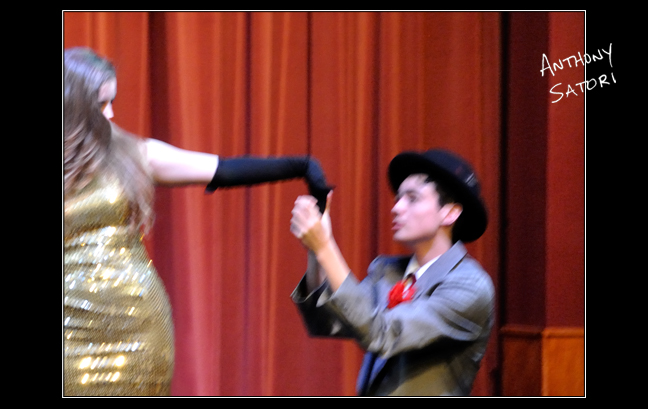
“Infatuation” | Anthony Satori
“The first sip is joy and the second is gladness, the third is serenity, the fourth is madness, the fifth is ecstasy.”
— Gary Snyder, describing to Jack Kerouac an ancient philosophy of drinking tea.
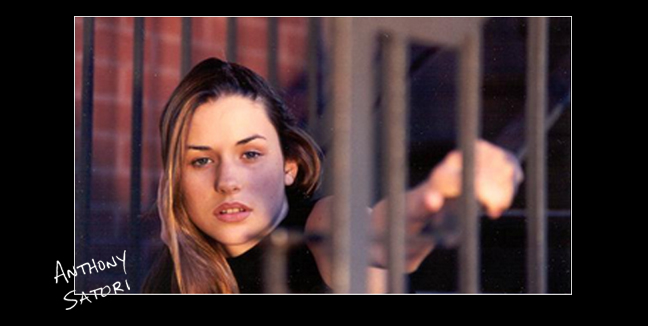
“Girl by a Fireside” | Anthony Satori
“Ah, life is a gate, a way, a path to Paradise anyway, why not live for fun and joy and love or some sort of girl by a fireside, why not go to your desire and LAUGH?”
— Jack Kerouac
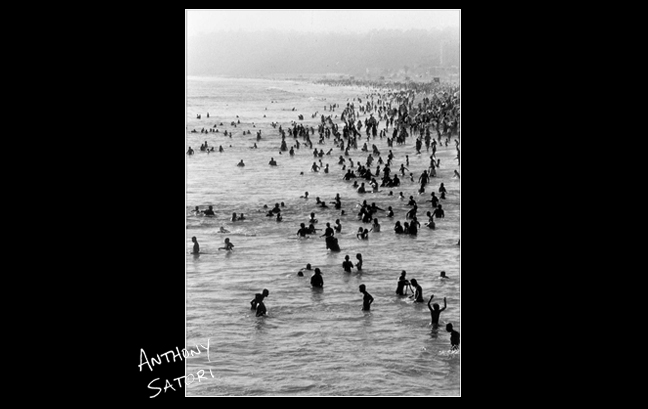
“Sea of Humanity” | Anthony Satori
“A breaking up of foam and of quicksand, / a rustling of salt withdrawing, / the grey cry of sea-birds on the coast.”
— Pablo Neruda
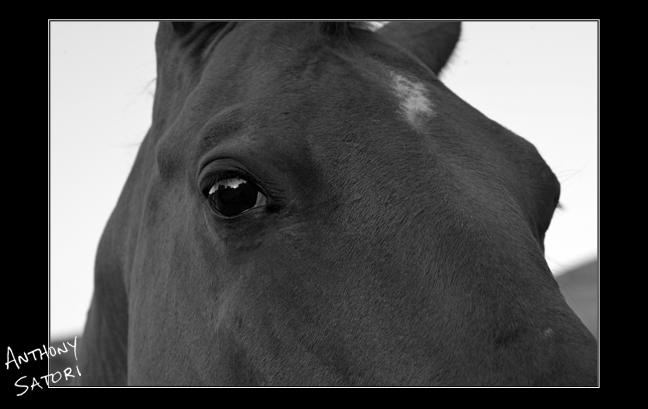
“Horse Soul” | Anthony Satori
“I see something of God each hour of the twenty-four, and each moment then.”
— Walt Whitman
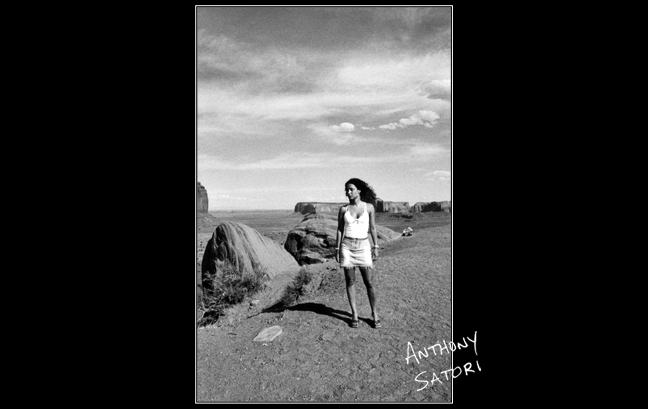
“The Eternal Hush of Silence” | Anthony Satori
“Listen closely… the eternal hush of silence goes on and on throughout all of this… this is because the world is nothing but a dream.”
— Jack Kerouac
 Satori Circle | Art & Culture