Other Spirits

“Woman Walking on Stone Pathway (Bellagio, Italy)”  |  Anthony Satori

Not long ago, I visited a small lake-side town in northern Italy called Bellagio.  On an early morning stroll, I took a photograph of the rising sun washing over a stone pathway that weaved upward from the main promenade.  As I took the picture, I was struck by how this small road had surely remained essentially unchanged for years, decades, even centuries, and I was inspired by the wonder and romance of this notion.

Not long after returning to the States, I came across a relatively obscure collection of photographs taken by one of the most influential pioneers of photography from the early 20th Century, Alfred Stieglitz.  I already knew a fair amount about Stieglitz’ life and work as an early champion of photography as a legitimate medium of creative expression; however, these particular pictures had somehow escaped my experience up until now, perhaps because they were taken before he ever opened his first gallery, even before he moved to New York.

As I was enjoying the discovery of these remarkable early photographs, I ran across a particular image that caught my eye.  It was a picture that Stieglitz took of a small cobblestone pathway in a tiny lake-side town in northern Italy.  The photograph was titled, “A Road in Bellagio, 1894.”  I was amazed.  Here, over a hundred years before my having explored this small village and having taken a photograph expressing my awe at its beauty and timelessness, Stieglitz himself had walked along this very same cobblestone promenade and felt the very same creative impulse to capture an image of a small road weaving upward from its edge.  It is wonderful how art has the ability to connect us with other spirits, even over the centuries.

Here, then, are both of the images.  The image on the left is the photograph taken by me.  The image on the right is Alfred Stieglitz’ photograph, taken in 1894.

BlogImage - SatoriCircleDotCom - Aug 19 2015c

Reference to the Soul

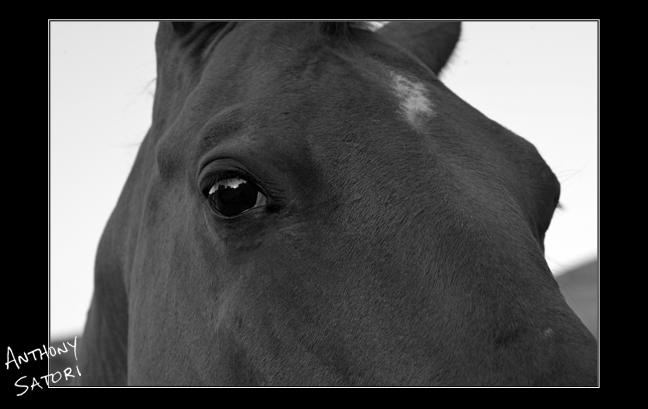
"Two Horses"  |  Anthony Satori

“Two Horses”  |  Anthony Satori

“I will not make a poem nor the least part of a poem but has reference to the soul.  Because having look’d at the objects of the universe, I feel there is no one nor any particle of one but has reference to the soul.” 

— Walt Whitman

O Night, O Sweetest Time

“Blackfriars Bridge at Night (London)”  |  Anthony Satori

“O night, O sweetest time, though dark of hue, with peace you force all restless work to end.  Those who exalt you see and understand, and he is sound of mind who honors you.  You send to this low sphere the dreams where we ascend up to the highest.”

— Michelangelo

Days of Wine and Sunshine

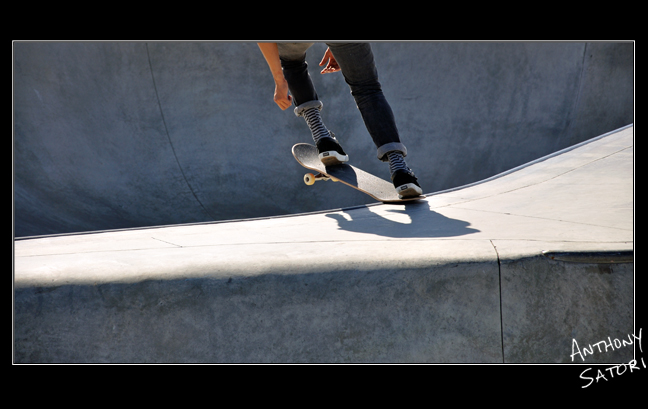
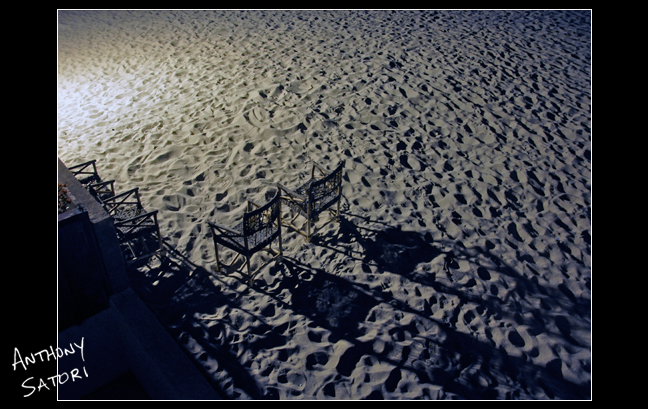
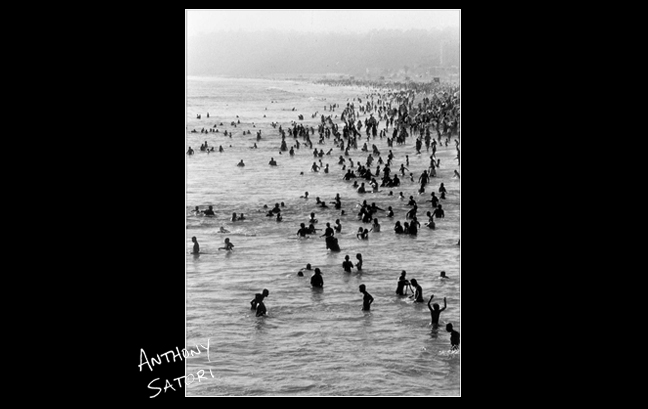
"Days of Wine and Sunshine"  |  Anthony Satori

“Days of Wine and Sunshine”  |  Anthony Satori

“My joys here are great, because they are very simple and spring from the everlasting elements: the pure air, the sun, the sea and the wheaten loaf.”

— Nikos Kazantzakis

Amber Droplet

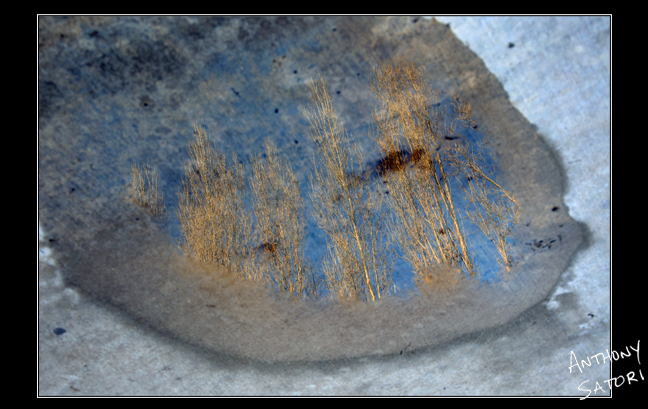
"Amber Droplet"  |  Anthony Satori

“Amber Droplet”  |  Anthony Satori

“God is shown to me no more fully than in some lovely mortal veil.  My eyes that ever long for lovely things, my soul that seeks salvation, cannot rise to heaven unless they fix their gaze on beauty, for they have no other wings.”

— Michelangelo

Sky Waves

"Sky Waves"  |  Anthony Satori

“Sky Waves”  |  Anthony Satori

“Heaven is in everything.  Follow the light, hide in the cloudiness, and begin in what is. Do this and your understanding will be like not understanding and your wisdom will be like not being wise.  By not being wise you will become wise.” — Chuang Tzu

The Universe is made up of vibrations and waves.  Everything is in motion, everything hums, everything is infused with energy.  Find the vibrations that resonate with the best vibrations in your own soul and place your attention there.  Do this consistently and with care, and synergy will result… your world will become greater than the sum of its parts.  Contribute your own best vibrations to the vibrations of the Universe, and harmony will arise… your life will become music.  This is the Tao of living well.

BlogImage-footd

Neptune in Repose

“Neptune in Repose”  |  Anthony Satori

Neptune is the Roman equivalent to the Greek god Poseidon.  He is widely recognized as the god of the sea, standing strong and regal with his trident, heavily bearded and boldly postured, exerting great power over his underwater domain.  His realm extends beyond the ocean floor, as well, since, as the ruler of water and climate, he is also the god of storms, wind and rain.  He can provide safe passage to sea-faring vessels, or, just as quickly, he can bring them to their doom.  He is also the provider of life-giving rainfall to agricultural endeavors, the filler of rivers and lakes with fish, and the one who causes underground springs to overflow with fresh drinking water.

Surely a deity of such breadth and reach deserves his own festival.  And, as it happens, tomorrow, July 23, marks the ancient Roman festival of Neptunalia.  Placed squarely in the heart of the dry season, this pleasant social event was slated as a time to celebrate the god Neptune and to implore him to bring more life-giving rain.  Often, a bull would be sacrificed as a symbol of agricultural fertility, and then the people would celebrate with the traditional activities of having a feast in the shade of shelters built with tree branches, drinking spring water, and sharing a pleasant, joyful time with friends.  During this festival, many of the standard social restrictions were lifted, giving people the opportunity to interact with others that they might not usually have the chance to meet.  What better time to get together with friends, share a meal, and perhaps open yourself up to the possibility of meeting someone new?

Neptunalia is also a good time to reconsider our own relationship with water, both literally and symbolically.  Many ancient religions place great importance on the metaphorical lessons that can be learned from water’s unique combination of fluidity, quiet patience, and immense power.  “Nothing is softer or more flexible than water, yet nothing can resist it.”  (Lao Tzu)  There is much that we can learn from observing water, such as how to adapt to our environment while staying true to our core selves, going with the flow instead of fighting it, and finding creative solutions to challenges. 

So, in celebration of Neptunalia, I encourage you to get together with some friends, share a feast, raise a glass of water, and open your mind to the flow of the Universe.  You might be pleasantly surprised where it takes you!

BlogImage-footd

Long Live Atticus Finch

“Long Live Atticus Finch”  |  Anthony Satori

“Mockingbirds don’t do one thing but make music for us to enjoy.  They don’t eat up people’s gardens, don’t nest in corncribs, they don’t do one thing but sing their hearts out for us.  That’s why it’s a sin to kill a mockingbird.”  — Harper Lee

The “new” book attributed to Harper Lee, Go Set a Watchman, purports to be the long-delayed release of a “sequel” to the literary masterpiece To Kill a Mockingbird, but I find the entire situation dubious. 

First of all, the timing of the “discovery” of this previously unpublished manuscript, and its presentation as a novel that Harper Lee “always wanted published,” seems highly questionable to me.  I find it difficult to believe that Harper Lee, one of the best-selling and widely-adored novelists of the 20th century, could not have had anything she wished published at any moment in her long life.  If she wanted this book out, it would have been out years ago, even decades ago.  The timing of its release, following the death of Harper Lee’s sister, a staunch defender of Lee’s legacy and work, smacks to me of a manipulative money-grab by people around the 89-year-old author, and it is unconscionable, in my opinion, because it is at the expense of nothing less than her legacy.  

Which brings us to the second point: the content of the book.  The story takes place 20 years after the events of the original, and purports to describe how, later in life, the virtuous hero of To Kill a Mockingbird, Atticus Finch, eventually conforms to the petty, racist narrow-mindedness of the world around him.  This, however, in my opinion, is something that Harper Lee would have never wanted.  My evidence of this?  If you read the original To Kill a Mockingbird carefully, you will see that it is not written from the viewpoint of the child “Scout,” as many people think.  The book is actually written from the viewpoint of the adult Scout, looking back on her childhood.  The key here is that she not only holds her father Atticus Finch up as a character of heroic virtue, kindness and strength from the perspective of a wide-eyed child, but that her love and respect for him remains unabated into her adult years.  This was no accident.  It tells me that Harper Lee wanted to secure the notion that the virtue and character of Atticus Finch never changed, never faltered, even later in life, as this “new” book seems to suggest that it did.

We readers, however — we lovers of literature, we champions of culture — can help preserve the legacy of a great writer and an amazing book by merely choosing to relegate this “sequel” to the status of the false work that it is, and by choosing to retain the original masterpiece To Kill a Mockingbird as the final word on the world created by Harper Lee.  Because, while it is a sin to kill a mockingbird, it is far worse, in my opinion, to attempt to kill the very heart and virtue of the defender of mockingbirds, Atticus Finch.

There are two things, then, that we can learn from this situation.  First, if you are a writer and you have work that you do not wish to be published, destroy it.  Don’t imagine that it will be looked upon in the proper light and/or reasonably presented at some future time.  You cannot count on this happening.  And second, we must cherish our classics in literature.  We must appreciate, preserve and celebrate wonderful books such as To Kill a Mockingbird, The Old Man and the Sea, The Fountainhead… any work that presents virtue as a truly heroic, yet humanly attainable character trait.  Books such as these represent the height of what literature is capable of doing, presenting us with higher versions of humanity to which we can aspire, and giving us a blueprint from which we can forge the mettle of our own character and become better versions of ourselves.

Long live Atticus Finch.

BlogImage-footd