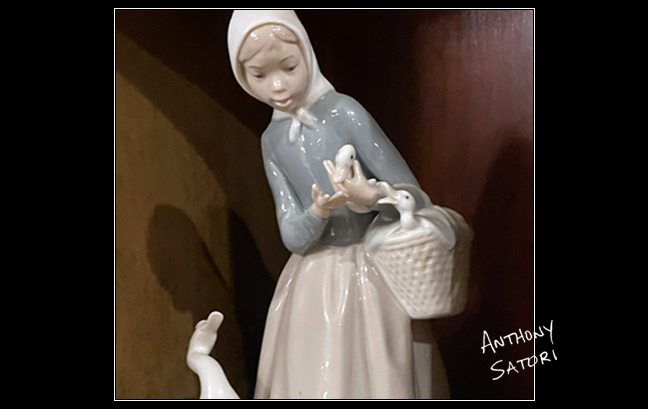
“Girl with Ducks” | Anthony Satori
“You do not have to be responsible for the world you are in. Just do your part, as well as you can. That is enough.”
– John von Neumann
“Girl with Ducks” | Anthony Satori
“You do not have to be responsible for the world you are in. Just do your part, as well as you can. That is enough.”
– John von Neumann
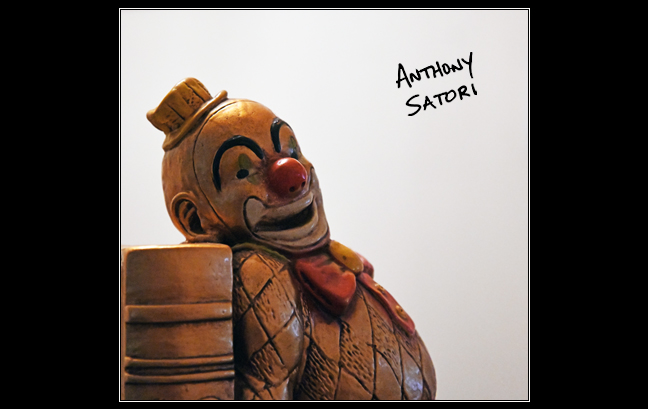
“Golden Clown and Book” | Anthony Satori
“No, no, it’s not books at all you’re looking for! Take it where you can find it, in old phonograph records, in old motion pictures, and in old friends; look for it in nature and look for it in yourself. There is nothing magical in books at all. The magic is only in what books say.”
– Ray Bradbury
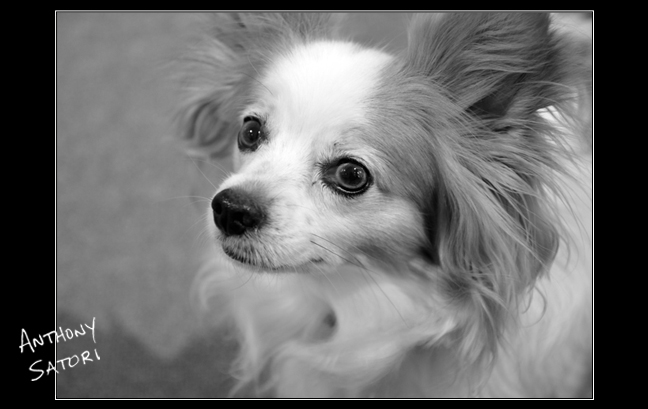
“Papillon” | Anthony Satori
“What is done in love is well done.”
– Vincent van Gogh
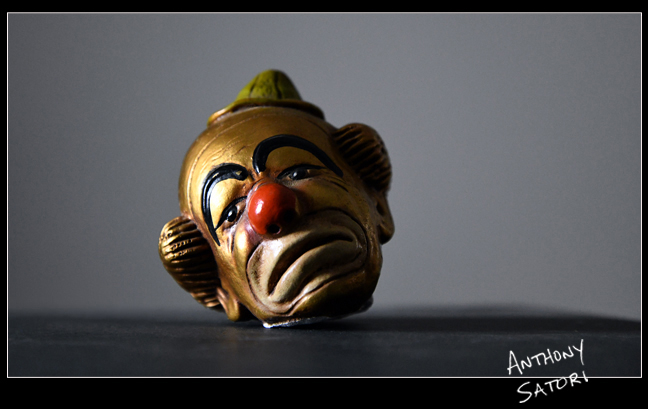
“The Enigmatic Phenomenon of Clowns” | Anthony Satori
Clowns are such oddly polarizing figures. Some people love them, with deep affection. Others dislike them, with equal intensity. Many people are even afraid of them. But almost everyone has a strong reaction to clowns, one way or another.
Clowns are something of a paradox, as well, in that they deliberately hide their identities beneath layers of paint and outlandish costumes, and yet they lay themselves bare before us by means of their exaggerated gestures, movements, and facial expressions. They throw themselves wholeheartedly into absurd and even dangerous situations in an earnest attempt to make us laugh, gasp, and feel something. We root for them, we fear for them, and we sigh in relief when they escape unscathed.
Every move a clown makes is an effort to capture and hold our attention – to gain our sympathy, to draw our empathy – to be seen and understood by us. And in a way, this makes them a true mirror of the human condition. Perhaps this is why audiences react to clowns in such an intense manner. Maybe their antics hit closer to home than we realize, as we watch these strange, cartoonish figures performing exaggerated and unapologetic presentations of the human need to be seen and appreciated and loved.
And when they cry, it manifests in such an over-wrought caricature of emotion that it can often make us feel uncomfortable. The dissonance of their tears is heightened even further by being juxtaposed with such lighthearted and colorful facades. These are the axiomatic “tears of a clown.” They are expressions of sadness coming from a face with a painted-on smile, and we feel these tears in a uniquely poignant way. Maybe we see something of ourselves in this, as well: the act of wearing a face that says, “everything is alright,” while inside we may be feeling sad, lost, or even depressed.
Upon reflection, it seems that clowns may be a more apt representation of humanity than we might have ever imagined.

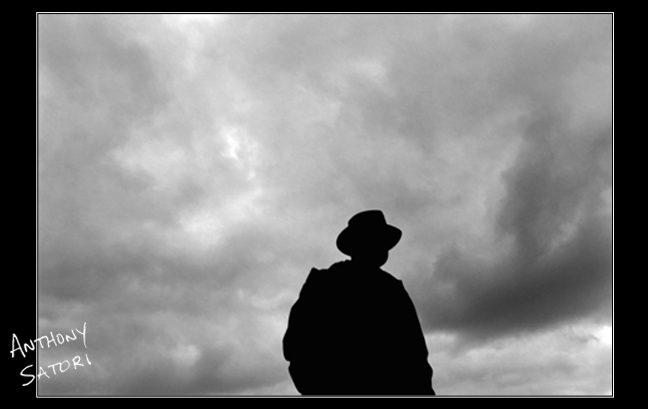
“Big Sky” –|– Anthony Satori
“Life shrinks or expands in proportion to one’s courage.”
— Anais Nin
Strive to live your life with vision, heart, principle, and courage. The universe honors these values.

“Loyal Heart” | Anthony Satori
“The greatest thing you’ll ever learn, is just to love and to be loved in return.”
— Eden Ahbez

“Meerkat Dreaming” | Anthony Satori
“For everything that lives is holy, life delights in life.”
— William Blake
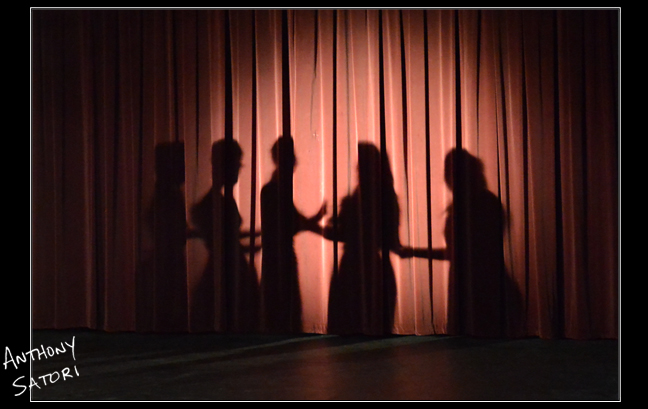
“Shadows of Burgundy” | Anthony Satori
“It is only with the heart that one can see rightly; what is essential is invisible to the eye.”
— Antoine de Saint-Exupery
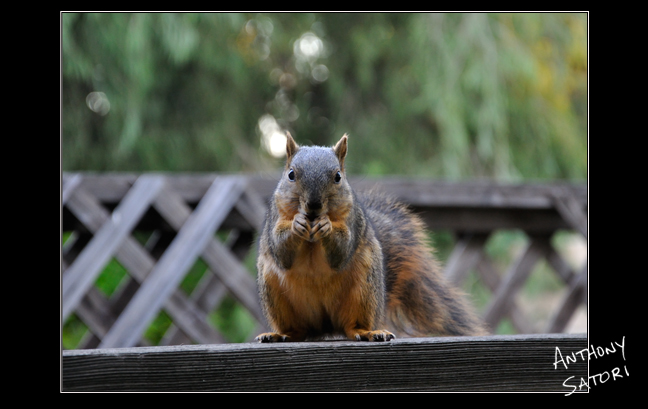
“Pecan” | Anthony Satori
“To photograph is… when all faculties converge to capture fleeting reality. It’s at that precise moment that mastering an image becomes a great physical and intellectual joy.”
— Henri Cartier-Bresson
Not long ago, I heard a squirrel making tracks across the roof of my house. I heard him on numerous occasions, and each time I would hear his little feet scurry across the tiles, I became more and more curious to see what my little animal friend looked like.
One morning, after hearing him dash across my rooftop, I went out into the yard and spotted him in a nearby tree. He could see me, but he did not move. I slowly and carefully took a large shelled pecan from my pocket and placed it on the top of a wooden fence. I then stood near the fence and waited. He spotted the treat almost immediately from his perch. I could tell that he wanted to eat the pecan very badly, but he was also still unsure. After a couple of short minutes, however, he must have decided that I was okay, because he cautiously walked over to within just a few feet from where I was standing and picked up the nut. Much to my delight, he did not run away with it, but instead sat upright, looked me straight in the eye, and hungrily nibbled away. I stayed very still, speaking quietly to him, telling him how polite I thought he was for staying near and eating it in my presence. As he nibbled, I even managed to take a photograph of him. (The image above.) When he finished the nut, he ran off into the tree again, turned around, and continued to watch me carefully from his branch.
After a moment, I very deliberately reached into my pocket and pulled out another delicious pecan. I showed it to him and then placed it in the same spot on the wooden fence. This time, he did not hesitate. He climbed down from the tree, loped over to where I stood, and picked up the nut in his little hands. Prudently deciding to save this one for later, he put it into his mouth, turned, and ran off. He swept quickly across the fence and lept onto the brick wall at the edge of my yard. With one last look at me, he flew across the top of the distant wall at lightning speed, and I managed to capture one more photograph. (That image –“Fleeting Reality” — can be seen here: http://bit.ly/2jaaRGP) He then disappeared into the trees and I returned inside, feeling very content about the events of the morning.
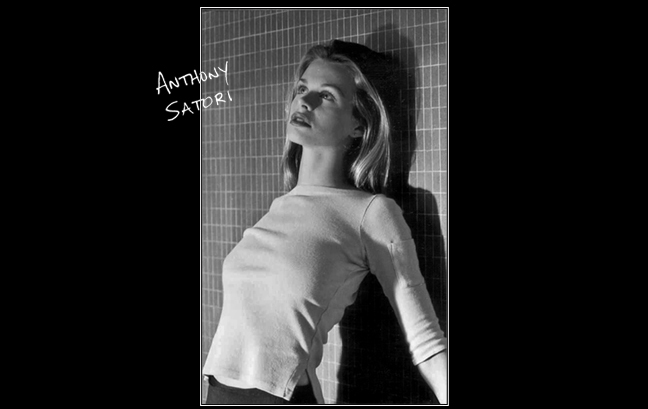
“Dreamer” | Anthony Satori
“We are the music makers… we are the dreamers of dreams… we are the movers and shakers… of the world, forever, it seems.”
— Arthur O’Shaughnessy
 Satori Circle | Art & Culture