“Optimistic people play a disproportionate role in shaping our lives. Their decisions make a difference; they are inventors, entrepreneurs, political and cultural leaders – not average people. They got to where they are by seeking challenges and taking risks.”
“That’s been one of my mantras – focus and simplicity. Simple can be harder than complex: You have to work hard to get your thinking clean to make it simple. But it’s worth it in the end because once you get there, you can move mountains.”
“They say that it’s an inexhaustible well. The thing that comforts me about it is the idea that all of this is from a singular Source. And that this Source is ultimately kind. And even though we may not understand the intentions of this Source, we are all connected and bound by it.”
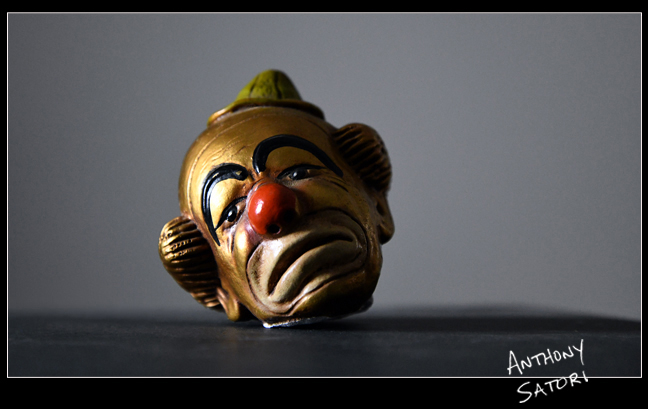
“The Enigmatic Phenomenon of Clowns” | Anthony Satori
Clowns are such oddly polarizing figures. Some people love them, with deep affection. Others dislike them, with equal intensity. Many people are even afraid of them. But almost everyone has a strong reaction to clowns, one way or another.
Clowns are something of a paradox, as well, in that they deliberately hide their identities beneath layers of paint and outlandish costumes, and yet they lay themselves bare before us by means of their exaggerated gestures, movements, and facial expressions. They throw themselves wholeheartedly into absurd and even dangerous situations in an earnest attempt to make us laugh, gasp, and feel something. We root for them, we fear for them, and we sigh in relief when they escape unscathed.
Every move a clown makes is an effort to capture and hold our attention – to gain our sympathy, to draw our empathy – to be seen and understood by us. And in a way, this makes them a true mirror of the human condition. Perhaps this is why audiences react to clowns in such an intense manner. Maybe their antics hit closer to home than we realize, as we watch these strange, cartoonish figures performing exaggerated and unapologetic presentations of the human need to be seen and appreciated and loved.
And when they cry, it manifests in such an over-wrought caricature of emotion that it can often make us feel uncomfortable. The dissonance of their tears is heightened even further by being juxtaposed with such lighthearted and colorful facades. These are the axiomatic “tears of a clown.” They are expressions of sadness coming from a face with a painted-on smile, and we feel these tears in a uniquely poignant way. Maybe we see something of ourselves in this, as well: the act of wearing a face that says, “everything is alright,” while inside we may be feeling sad, lost, or even depressed.
Upon reflection, it seems that clowns may be a more apt representation of humanity than we might have ever imagined.
“The best thing is to keep a balance in your life, to acknowledge the great powers around us and within us. If you can do that, and live that way, you are truly wise.”
“It is the possession of a great heart or a great mind, and not the mere fame of it, which is worth having and which is conducive to happiness. Not fame, but that which deserves to be famous, is what one should hold in esteem. Fame itself is only an accident.
Likewise, one who deserves fame without getting it possesses by far the more important element of happiness. It is not that a person is thought to be great by the masses… but that a person really is great, which should move us to value their position. And their happiness should not derive from the fact that posterity may hear of them, but rather from the fact that they are the creator of thoughts worthy to be treasured and studied.”
“What’s wrong is not a problem with the great discoveries of science. Information is always better than ignorance, no matter what information or what ignorance. What is wrong is the belief behind the information, the belief that information will change the world. It won’t. Information without human understanding is like an answer without its question: meaningless. And human understanding is only possible through the arts and humanities. It is the work of art that creates the human perspective in which information turns to truth.”
– Archibald MacLeish
One of the most startling revelations of quantum physics over the last century has been the assertion that, at the most fundamental levels of existence, there are virtually no inexorable truths or inherent meanings – just pure energy. Put another way: the closer we get to the subatomic realm, the more we discover that the cosmos seems to be made up entirely of nothing more than field equations and mathematical probabilities. All of the numbers, all of the wave functions, all of the raw data – all that they actually seem to be doing is merely suggesting or indicating a probability that some or other discrete particle, phenomenon, or event will occur at some particular point in time and space. Beyond this, there is, arguably, essentially nothing – that is, no “thing” – or perhaps more accurately, some varying probability of “everything.”
It seems that it is only when a conscious mind observes a particular particle or phenomenon that it becomes – almost mystically – transformed from a probabilistic wave function into something that is truly unique, measurable, and discrete. Conscious awareness alone, then, seems to be the singular mechanism in the universe which has the power to transform pure energy into something which has substance, meaning, and truth. And it is the arts and humanities – encompassing, in my view, acts of creativity, kindness, and love, and experiences of transcendence, enlightenment, and spiritual revelation – which, at their best, connect us most directly with this higher consciousness in our human nature, and thereby empower us to become the most effective co-creators of our own universe.
Let us then strive to use these profound gifts mindfully, compassionately, nobly, and constructively. Let us endeavor to make this the best of all possible worlds.
“In dwelling, live close to the ground. In thinking, keep to the simple. In conflict, be fair and generous. In governing, don’t try to control. In work, do what you love. In family life, be completely present.”




 Satori Circle | Art & Culture