Bright Like a Diamond

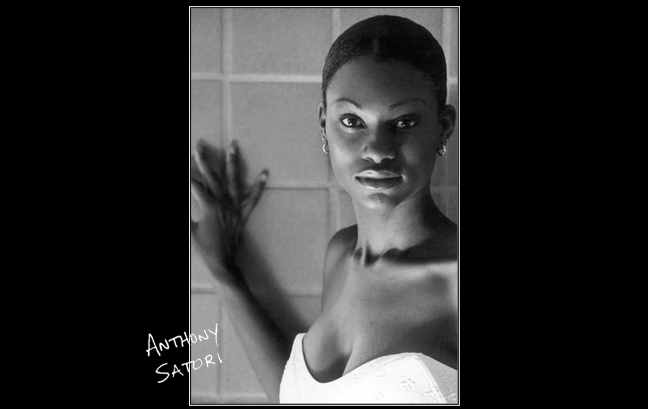
"Portrait of M"  |  Anthony Satori

“Portrait of M”  |  Anthony Satori

“The light of the sun seems to be poured down, and to be poured, indeed, in every direction, but not poured away; for this pouring is an extension, and that is why the sun’s beams are called ‘rays’ (aktines), because they are extended (ekteinesthai). 

“And what kind of thing a ray is you can readily see if you look at sunlight entering a darkened room through a narrow opening.  For it stretches out in a straight line and comes to rest, so to speak, on any solid body that intercepts it, cutting off the air that lies beyond; and there it rests, neither slipping off nor falling down.

“The pouring forth and diffusion of our understanding should follow a comparable pattern, and by no means be a pouring away, but rather, an extension; and it should not make a forcible or violent impact on the obstacles that it encounters nor sink down, but stand firm and illuminate the object that receives it, for that which fails to welcome it will deprive itself of light.”

– Marcus Aurelius

Magic and Beauty

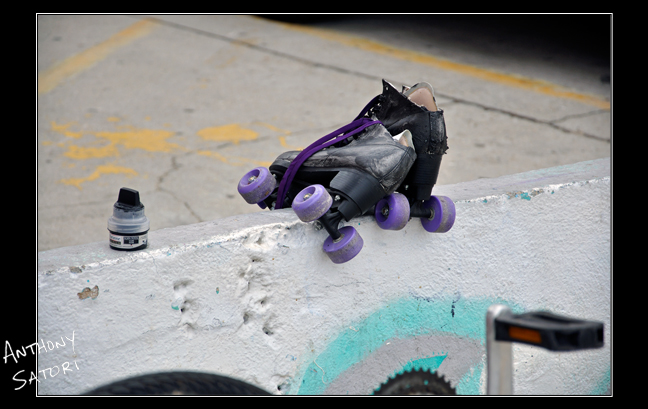
“Purple Skates”  |  Anthony Satori

“The appearance of things changes according to our emotions.  Thus we see magic and beauty in them, while the magic and beauty are really in ourselves.” – Khalil Gibran

As an artist, my vocation is to create images that reveal to you the magic and beauty that pulses through the world around us.  But perhaps what I am really doing is revealing the magic and beauty in you.

BlogImage-footd

Momento

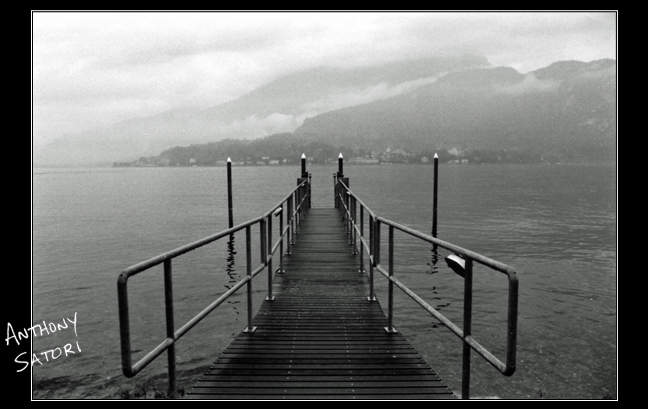
"Pier Over Lake Como"  |  Anthony Satori

“Pier Over Lake Como”  |  Anthony Satori

It was early morning on the shores of Lake Como, northern Italy.  I took a deep breath and savored the quiet beauty of the surroundings.  A small motor boat appeared through the fog and docked at the end of the pier, waiting for us to board.  Our group began to walk along the wooden planks toward where the vessel gently rocked in the water.  About halfway down the pier, I moved to affix the lens cap to the end of my camera, but as I did, it slipped from my grasp.  There was a gasp as we watched it spin through the air, seemingly in slow motion, bounce one time off the wood, clear the edge of the pier, and then drop unceremoniously through the surface of the water with a quiet bloop.  The lens cap then sank slowly to the bottom of the lake, coming to rest nearly ten feet under water.  We all watched in silence as it settled on the lake floor.  I gave a sigh.  The others looked at me to see what I would do.  I lifted my head, smiled and said, “It’s alright, it’s just a lens cap.  I can get another.”  I then turned and continued to walk toward the boat.  Taking my cue, the others turned to walk with me.

The Italian boatman, however, having watched the entire situation unfold, stepped off his boat and said to me with a thick Italian accent, “No, no, we get it.”  I began to protest, but quickly realized that my protestations would be to no avail as the kind boatman walked back onto his vessel and retrieved a pole with a small fishing net at the end of it.  He returned to where I stood with a smile in his eyes and a look of friendly determination on his face.  He asked me where the lens cap had landed.  I indicated an almost unseeable dark disc sitting deep in the clear water.  The boatman crouched down at the side of the pier and lowered the pole into the water, the net just barely reaching the lens cap where it lay.  He tapped it gently with the edge of the net, nudging it ever-so-slightly toward the shore.  At this point, everyone was watching with bated breath.  Every eye upon him, the kind boatman continued to gently tap the lens cap toward shore, get up and take a  few steps up the pier, and then reach down again with the net to tap it further.  The entire group stood watching each incremental move with rapt attention.  After numerous similar nudges, each yielding only the smallest of advances, he finally got the cap into shallow enough water where I could lean down over the side of the pier and retrieve it.  I pulled it up out of the water and lifted it into the air.  Everyone cheered.  The boatman stood up with a smile of triumph.  I thanked him, saying, “Grazie, signore, mille grazie.”  Feeling the appreciation, he smiled back at me and warmly replied, “Ti prego.”

Thus began our journey into Lake Como.  We started the day with a genuine show of kindness from a new friend, and the bonding that comes from a shared achievement, and this set the tone for the entire day.  As we boarded the boat, I quietly folded the still-wet lens cap into a small silk cloth and slipped it into a side pocket of my camera case.  Since that day, I have never rinsed nor cleaned that lens cap, instead keeping it just as it is, still touched with traces of the very water and earth of Lake Como, and imbued with a warm memory of a foggy morning in northern Italy.

BlogImage-footd

Icarus

"Icarus"  |  Anthony Satori

“Icarus”  |  Anthony Satori

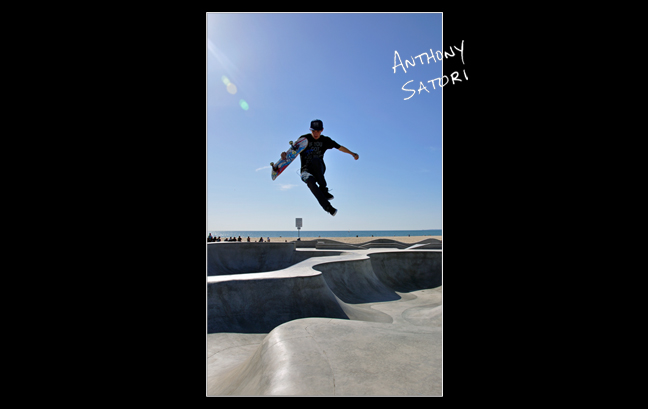
Whoever said that man was not meant to fly must have never been to a skate park.

To see someone get this kind of air on the sheer force of momentum, wheels and skill is exhilarating.  It brings to mind the oft-quoted words of airman and poet John Magee, “I broke the surly bonds of earth, and touched the face of God.”

John Gillespie Magee, Jr. was an American test pilot who tested fighter planes for the Royal Canadian Air Force in World War II.  His poem High Flight (1941) was inspired by test flights in the U.K. where his task was to fly high-performance planes straight up into the air, as fast and as high as he could, until the engine failed.  He would then recover control of the plane on the way down, restart the engine, and land.  Reaching higher into the sky than probably anyone before them, the pilots who performed these tests certainly had a unique perspective on the heavens.  In fact, the final line of the poem came to Magee just as he was reaching peak altitude of 30,000 feet in a Spitfire Mk1.  Upon safely landing the plane, he returned to his desk and finished writing the poem.  Sadly, only a few months later, during a similar flight test there was a mid-air collision, and, unable to eject because of a mechanical error with the plane’s canopy, Magee died in the crash.  He died doing what he loved, however, and he served the Allies bravely.  He also left us with some immortal lines of poetry.

Interestingly, there is a lesser-known line that Magee also wrote, but which is almost always left out when people quote the poem.  Even though the words as quoted are impactful, the omitted line has always provided an important dimension to the poem’s meaning, for me, so I have decided to include it here for you.  With the additional middle line, Magee’s poem reads,  “I broke the surly bonds of earth, reached out my hand, and touched the face of God.”  [my emphasis]  It seems to me that the reaching out of the hand is a vital part of the act.  We can fly high, yes, but unless we reach out our hand, perhaps we can never hope to touch the face of God.  We should aspire, most definitely, but then we must also take action, take risk, reach out our hand.  It seems to me that there is a very important message contained in this line, namely: the Universe responds to the reach.

So even if we are not leaping through the air on a skateboard, or climbing 30,000 feet in a fighter plane, we can each find inspiration to reach for new heights in our own lives.  And as we do, we should keep this in mind:  It is not the nature of the task, but the quality of the striving, that is of the essence.

BlogImage-footd

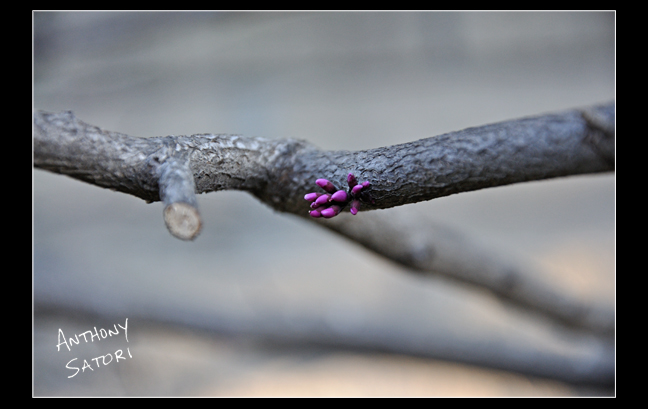
Gentle Beginnings

"Gentle Beginnings"  |  Anthony Satori

“Gentle Beginnings”  |  Anthony Satori

So here we are, approaching the Vernal Equinox, the beginning of Spring.  It is a time for renewal, for re-simplification, for immersing our senses in the vibrancy of life all around us.  It is a time to fall in love, again, with the simple pleasures of being alive: warm air, sunshine, the sky and the sea… music, friends, food and conversation.  It is a time to begin sowing fresh seeds of hope, cultivating nascent sparks of interest and desire, and cherishing the gentle beginnings of robust flowers.

BlogImage-footd

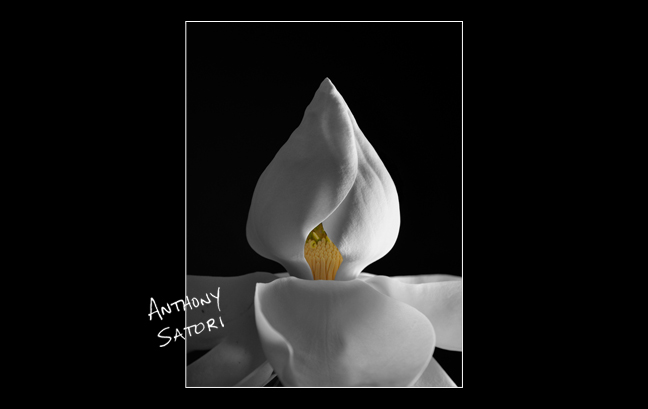
Beauty Is

"Eternity"  |  Anthony Satori

“Beauty Is”  |  Anthony Satori

“Beauty is life when life unveils her holy face.  But you are life and you are the veil.  Beauty is eternity gazing at itself in a mirror.  But you are eternity and you are the mirror.” – Khalil Gibran

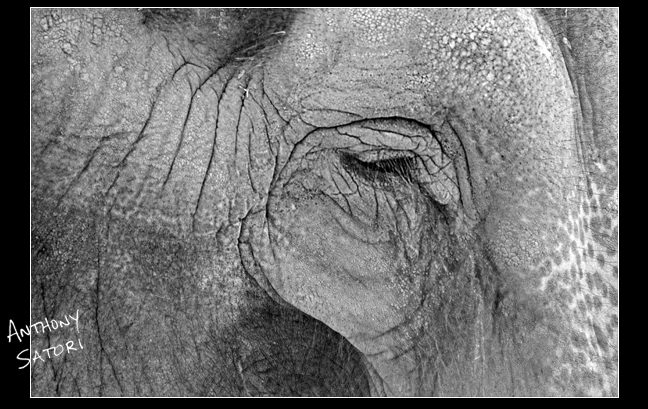
Elephant Soul

"Wise Elephant"  |  (Animal Spirits, pg.118)  |   Anthony Satori

“Elephant Soul”  |  (Animal Spirits, pg. 118)  |  Anthony Satori

“The happiness of your life depends upon the quality of your thoughts.” – Marcus Aurelius

From the moment we realize this concept, how could we not expend as much energy and attention as possible toward engaging our minds with thoughts of beauty, nobility, compassion and peace?

BlogImage-footd

Prana (Inner Light)

"Prana (Inner Light)"  |  Anthony Satori

“Prana (Inner Light)”  |  Anthony Satori

Ancient writings from the Indus Valley tell us that the universe within us is as vast as the universe outside of us.

     “As great as the infinite space beyond, is the space within the lotus of the heart.  Both heaven and earth are contained in that inner space, both fire and air, sun and moon, lightning and stars.  Whether we know it in this world or know it not, everything is contained in that inner space.”  (Chandogya Upanishad, 1.3)

I have always been fascinated by ancient texts, especially ones which strive to tell us something about the spiritual world.  Such writings have always felt to me a bit like “messages in a bottle,” sent by people who lived millennia in the past, ancient seekers who discovered certain truths about life that they believed to be of such profound importance that they were willing to employ every means at their disposal to preserve them for later generations to discover. 

In some of these texts, the Sanskrit term “Prana” is used to indicate Vital Energy, or Inner Light, referring to the spiritual energy field that vibrates within, around and through us.  Prana is our own personal breath of the Divine, our own individual connection to the Source of Life.  One of the realizations that these ancient seekers wished to share with us is that every human being holds the ability to connect with the Universal Spirit through meditation, introspection and study.  What an insight!  It is both empowering and humbling to realize that we each have the potential to explore the vastness of the Universe merely by quieting our thoughts, centering our minds, and remaining still long enough to discover it within ourselves.

BlogImage-footd