Long Live Atticus Finch

“Long Live Atticus Finch”  |  Anthony Satori

“Mockingbirds don’t do one thing but make music for us to enjoy.  They don’t eat up people’s gardens, don’t nest in corncribs, they don’t do one thing but sing their hearts out for us.  That’s why it’s a sin to kill a mockingbird.”  — Harper Lee

The “new” book attributed to Harper Lee, Go Set a Watchman, purports to be the long-delayed release of a “sequel” to the literary masterpiece To Kill a Mockingbird, but I find the entire situation dubious. 

First of all, the timing of the “discovery” of this previously unpublished manuscript, and its presentation as a novel that Harper Lee “always wanted published,” seems highly questionable to me.  I find it difficult to believe that Harper Lee, one of the best-selling and widely-adored novelists of the 20th century, could not have had anything she wished published at any moment in her long life.  If she wanted this book out, it would have been out years ago, even decades ago.  The timing of its release, following the death of Harper Lee’s sister, a staunch defender of Lee’s legacy and work, smacks to me of a manipulative money-grab by people around the 89-year-old author, and it is unconscionable, in my opinion, because it is at the expense of nothing less than her legacy.  

Which brings us to the second point: the content of the book.  The story takes place 20 years after the events of the original, and purports to describe how, later in life, the virtuous hero of To Kill a Mockingbird, Atticus Finch, eventually conforms to the petty, racist narrow-mindedness of the world around him.  This, however, in my opinion, is something that Harper Lee would have never wanted.  My evidence of this?  If you read the original To Kill a Mockingbird carefully, you will see that it is not written from the viewpoint of the child “Scout,” as many people think.  The book is actually written from the viewpoint of the adult Scout, looking back on her childhood.  The key here is that she not only holds her father Atticus Finch up as a character of heroic virtue, kindness and strength from the perspective of a wide-eyed child, but that her love and respect for him remains unabated into her adult years.  This was no accident.  It tells me that Harper Lee wanted to secure the notion that the virtue and character of Atticus Finch never changed, never faltered, even later in life, as this “new” book seems to suggest that it did.

We readers, however — we lovers of literature, we champions of culture — can help preserve the legacy of a great writer and an amazing book by merely choosing to relegate this “sequel” to the status of the false work that it is, and by choosing to retain the original masterpiece To Kill a Mockingbird as the final word on the world created by Harper Lee.  Because, while it is a sin to kill a mockingbird, it is far worse, in my opinion, to attempt to kill the very heart and virtue of the defender of mockingbirds, Atticus Finch.

There are two things, then, that we can learn from this situation.  First, if you are a writer and you have work that you do not wish to be published, destroy it.  Don’t imagine that it will be looked upon in the proper light and/or reasonably presented at some future time.  You cannot count on this happening.  And second, we must cherish our classics in literature.  We must appreciate, preserve and celebrate wonderful books such as To Kill a Mockingbird, The Old Man and the Sea, The Fountainhead… any work that presents virtue as a truly heroic, yet humanly attainable character trait.  Books such as these represent the height of what literature is capable of doing, presenting us with higher versions of humanity to which we can aspire, and giving us a blueprint from which we can forge the mettle of our own character and become better versions of ourselves.

Long live Atticus Finch.

BlogImage-footd

O me! O life!

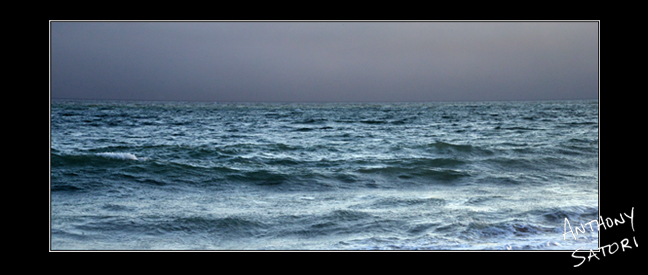
“Ocean Light”  |  Anthony Satori

“O me!  O life!  Of the questions of these recurring; of the endless trains of the faithless, of cities fill’d with the foolish — what good amid these, O me, O life?

Answer.  That you are here — that life exists, and identity; that the powerful play goes on, and you may contribute a verse.”

— Walt Whitman

Blur

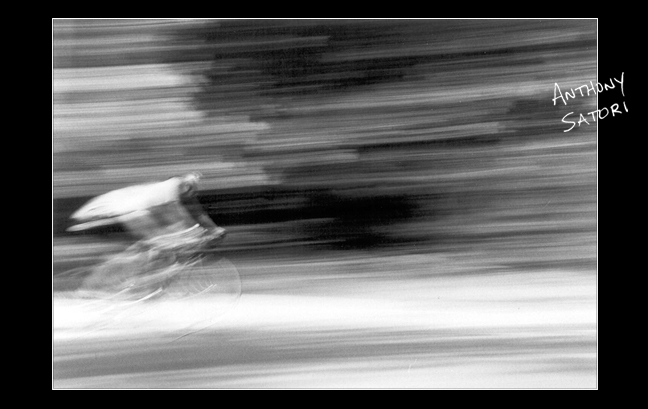
“Blur”  |  Anthony Satori

Einstein’s Special Theory of Relativity tells us that the velocity of a given observer directly and substantively affects the relative velocity of that which is being observed.

Put into a philosophical context:  If you race through life too quickly, the effect will be the same as life passing you by too fast.  If, however, you make a conscious effort to slow down and appreciate every moment, the Universe will respond by revealing nearly limitless opportunities for you to awaken and breathe.

“I sometimes think people don’t know what grass is, or flowers, because they never see them slowly.  If you showed someone a green blur, Oh yes! They’d say, that’s grass!  A pink blur! That’s a rose garden!  White blurs are houses.  Brown blurs are cows… Isn’t that funny, and sad, too?” — Ray Bradbury

Slow down.  Savor the moment.  Life was not meant to be experienced as a blur.

BlogImage-footd

Out There

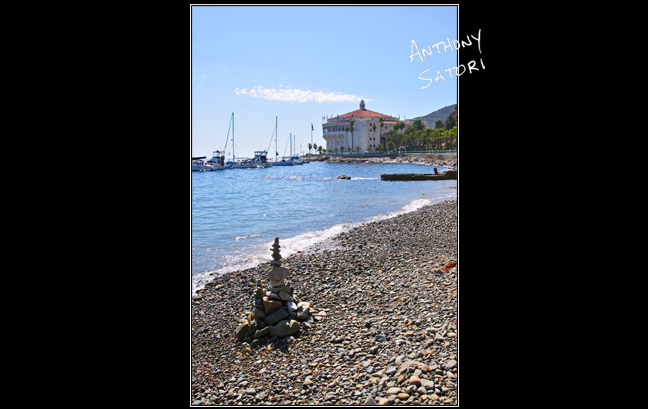
"Beach Rocks"  |  Anthony Satori

“Out There”  |  Anthony Satori

“Look at the world out there, my God, my God, look at it out there, outside me, out there beyond my face and the only way to really touch it is to put it where it’s finally me, where it’s in the blood, where it pumps around a thousand times ten thousand a day.  I get hold of it so it’ll never run off.  I’ll hold on to the world tight some day.  I’ve got one finger on it now; that’s a beginning.” Fahrenheit 451  (Ray Bradbury)  

Limitless

“Limitless”  |  Anthony Satori

“Out of my pocket I drew a little edition of Dante — my travelling companion. I lit a pipe, leaned against the wall and made myself comfortable.  I hesitated for a moment.  Into which verses should I dip?  Into the burning pitch of the Inferno, or the cleansing flames of Purgatory?  Or should I make straight for the most elevated plane of human hope?  I had the choice.  Holding my pocket Dante in my hand, I rejoiced in my freedom.  The verses I was going to choose so early in the morning would impart their rhythm to the whole of the day.” – Nikos Kazantzakis (Zorba the Greek)

Bright Like a Diamond

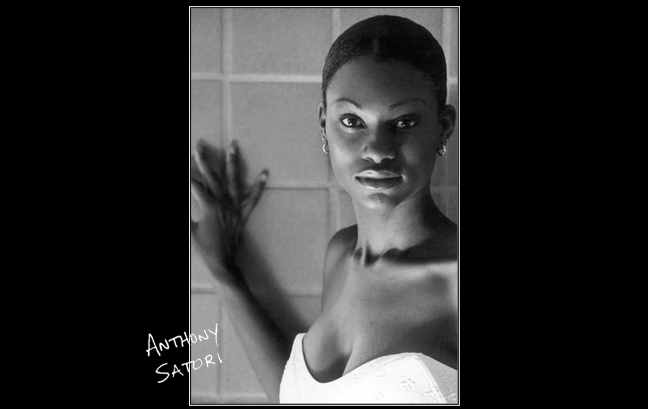
"Portrait of M"  |  Anthony Satori

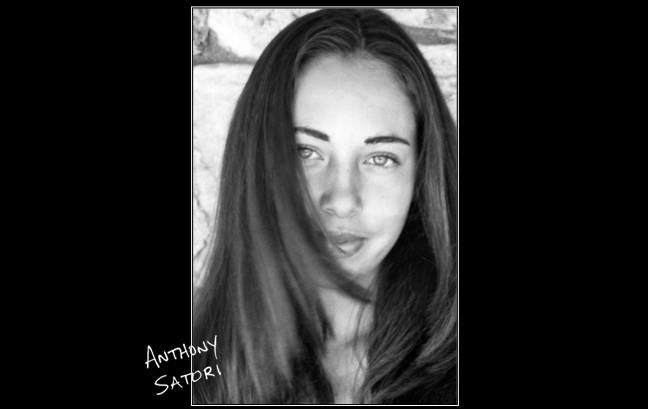
“Portrait of M”  |  Anthony Satori

“The light of the sun seems to be poured down, and to be poured, indeed, in every direction, but not poured away; for this pouring is an extension, and that is why the sun’s beams are called ‘rays’ (aktines), because they are extended (ekteinesthai). 

“And what kind of thing a ray is you can readily see if you look at sunlight entering a darkened room through a narrow opening.  For it stretches out in a straight line and comes to rest, so to speak, on any solid body that intercepts it, cutting off the air that lies beyond; and there it rests, neither slipping off nor falling down.

“The pouring forth and diffusion of our understanding should follow a comparable pattern, and by no means be a pouring away, but rather, an extension; and it should not make a forcible or violent impact on the obstacles that it encounters nor sink down, but stand firm and illuminate the object that receives it, for that which fails to welcome it will deprive itself of light.”

– Marcus Aurelius

Beauty Vérité

"Beauty Vérité"  |  Anthony Satori

“Beauty Vérité”  |  Anthony Satori

“She was beautiful, but not like those girls in the magazines. She was beautiful for the way she thought. She was beautiful for that sparkle in her eyes when she talked about something she loved. She was beautiful for her ability to make other people smile, even if she was sad. No, she wasn’t beautiful for something as temporary as her looks. She was beautiful, deep down to her soul.” 

– F. Scott Fitzgerald