Longing

“Longing” | Anthony Satori

Edgar Degas was a French painter from the Impressionist Period of the late 1800s and early 1900s. He was known for his delicate, dream-like paintings of ballet dancers and, later in his career, for his highly sympathetic images of women in domestic roles. During his lifetime, Degas’ paintings were very well-regarded, and he achieved both critical acclaim and financial success. Through the century following his passing, his stature as a great artist only increased with time. What many people don’t realize, however, is that, in addition to being an accomplished painter, Degas also made sculptures; or, rather, he wanted to make sculptures.

Degas, in fact, exhibited only one sculpture in his entire career: The Little Dancer of Fourteen Years (1881). It was a 1/3 life-size wax figure of a young girl striking a balletic pose, gazing upward with an enigmatic look on her face. She is wearing ballet shoes, a corset, and a skirt, with a white bow draped down her back. Upon its exhibition, it was so badly received by the public and by the critics, both for its “realism” and for its use of “unconventional” materials – including fabric-weaved tulle for the skirt, real human hair for the wig, and wax-coated ballet slippers on the feet – he took the piece down, brought it back to his studio, and never exhibited the artwork again. He was never to exhibit this sculpture – or any other sculptural work – for the remainder of his life. While he would continue over the next four decades to sculpt numerous figures in wax and clay in his studio – beautiful, graceful figures, mostly of women and horses – he never exhibited them publicly, and never cast even a single one of them in bronze.

Thankfully, after Degas passed away, his heirs discovered over 150 wax, clay, and plastiline sculptures in his studio, many of them still intact, and, within a couple of years, they enlisted Degas’ close friend and sculptor Albert Bartholomé to prepare over 70 of the best-preserved pieces for limited-edition bronze castings. Thus, the world was presented posthumously with an almost entirely never-before-seen body of sculptural artwork from an already world-famous painter, and the works have been shown and enjoyed throughout the world in museum collections ever since.

How poignant, to think that even an artist of such fame and renown as Edgar Degas could have been stung so badly by a single bad reception of a solitary piece of work that he never exhibited another sculpture in his lifetime. The world was almost kept from experiencing a complete “second” body of work from a quite wonderful artist, merely due to the callousness of a handful of critics. Thankfully, he had the pure desire and self-motivation to continue to create sculptural works for his own pleasure and edification, and, as a result, we have them to enjoy and appreciate today.

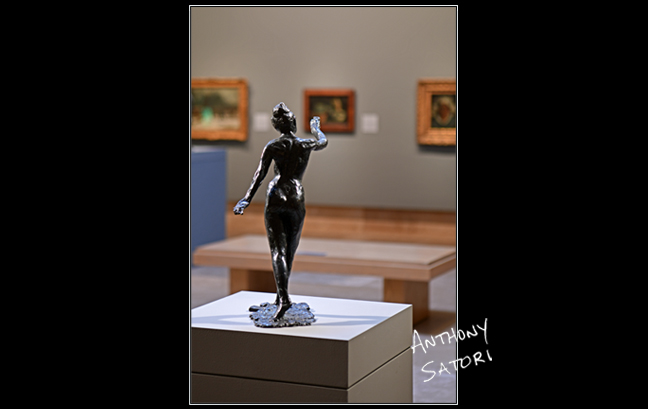
If you are curious to see what the infamous Little Dancer looks like, I have included my own photograph of it below. In terms of Degas’ sculptural career, this is the artwork that started (and almost ended) it all.

___________________
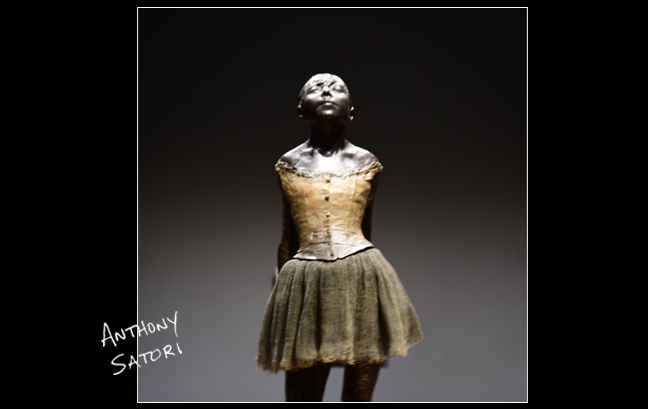
“Degas’ Little Dancer of Fourteen Years” | Anthony Satori
The Alchemy of Art

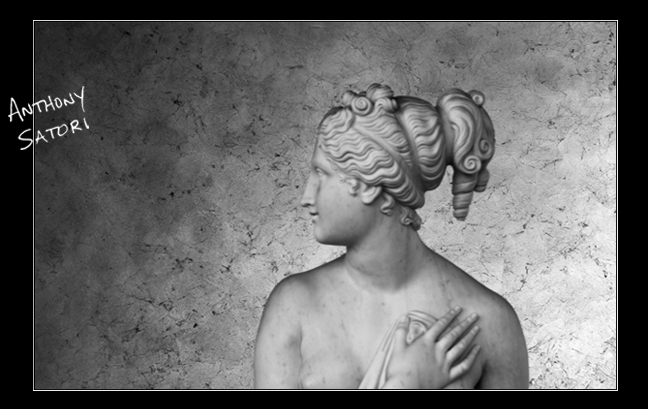
“Shy Venus” | Anthony Satori

“What’s wrong is not a problem with the great discoveries of science. Information is always better than ignorance, no matter what information or what ignorance. What is wrong is the belief behind the information, the belief that information will change the world. It won’t. Information without human understanding is like an answer without its question: meaningless. And human understanding is only possible through the arts and humanities. It is the work of art that creates the human perspective in which information turns to truth.”

– Archibald MacLeish

One of the most startling revelations of quantum physics over the last century has been the assertion that, at the most fundamental levels of existence, there are virtually no inexorable truths or inherent meanings – just pure energy. Put another way: the closer we get to the subatomic realm, the more we discover that the cosmos seems to be made up entirely of nothing more than field equations and mathematical probabilities. All of the numbers, all of the wave functions, all of the raw data – all that they actually seem to be doing is merely suggesting or indicating a probability that some or other discrete particle, phenomenon, or event will occur at some particular point in time and space. Beyond this, there is, arguably, essentially nothing – that is, no “thing” – or perhaps more accurately, some varying probability of “everything.”

It seems that it is only when a conscious mind observes a particular particle or phenomenon that it becomes – almost mystically – transformed from a probabilistic wave function into something that is truly unique, measurable, and discrete. Conscious awareness alone, then, seems to be the singular mechanism in the universe which has the power to transform pure energy into something which has substance, meaning, and truth. And it is the arts and humanities – encompassing, in my view, acts of creativity, kindness, and love, and experiences of transcendence, enlightenment, and spiritual revelation – which, at their best, connect us most directly with this higher consciousness in our human nature, and thereby empower us to become the most effective co-creators of our own universe.

Let us then strive to use these profound gifts mindfully, compassionately, nobly, and constructively. Let us endeavor to make this the best of all possible worlds.

The Mystical Nature of Music

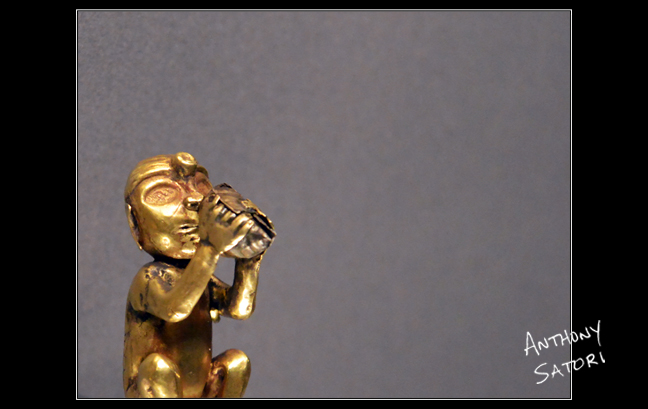
“Golden Conch Shell” | Anthony Satori

“Music has always been a matter of Energy to me, a question of Fuel. Some people call it Inspiration, but what they really mean is Fuel. I have always needed Fuel. I am a serious consumer. On some nights I still believe that a car with the gas needle on empty can run about fifty more miles if you have the right music playing very loudly on the radio.”

— Hunter S. Thompson

The music of the conch shell, for many cultures, has for millennia been the means for calling together the community for celebration, ritual, or a collective endeavor of some kind. For other cultures, it has represented a musical entreaty to communicate with the supernatural world. And for other cultures still, the conch produces nothing less than the sound from which the very universe was created.

Jupiter and Saturn in Conjunction

“Jupiter and Saturn in Conjunction” | Anthony Satori

“The ninety and nine are with dreams content.
But the hope of the world made new
Is the hundredth person who is grimly bent
On making dreams come true.”

— Ted Olson

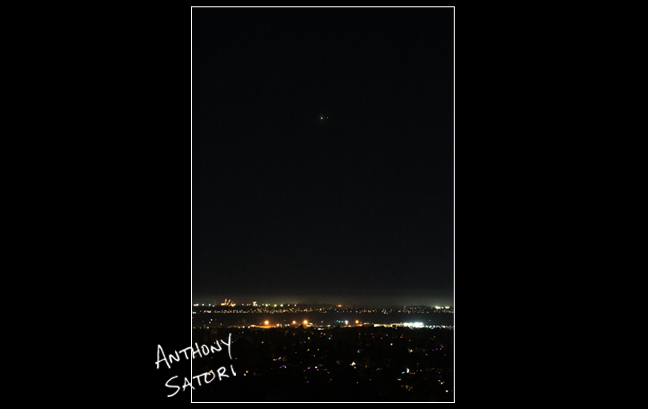
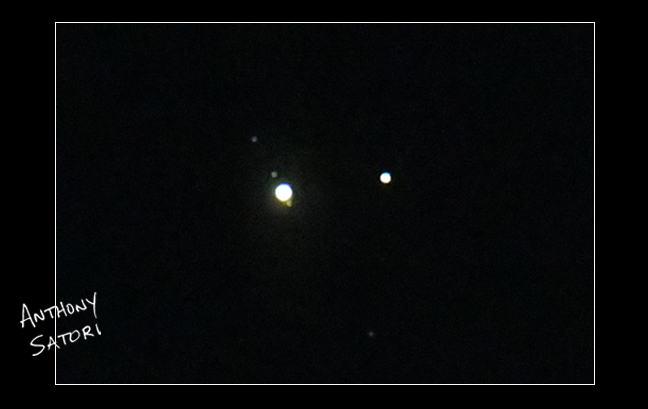
I took this photograph just a few weeks ago, on December 21, 2020. At first blush, it may not be evident why this image might be of particular note. The two lights in the sky, however, are the planets Jupiter and Saturn, and they are in “conjunction” — which means that on this particular night these two celestial bodies were visibly closer together in our sky than they have been in nearly 800 years. The last time they appeared this close (0.1 degree apart) was 1226 AD. Merely to be alive to witness the recurrence of such a phenomenon is quite amazing. To top it off, however, this incredibly rare event occurred on Winter Solstice (for the Northern Hemisphere), which feels doubly auspicious.

Winter Solstice is the longest, darkest, and often coldest night of the year. In this moment, we are the farthest from the Sun than at any other time. It also means, however, that a shift is occurring. Things are now beginning to turn around, and to move back toward the renewal of life, toward the expansion of light and warmth, and toward the rejuvenation that comes with springtime.

Keep faith, everyone. The planets have aligned.

(See below for a more close-up photograph of the conjunction!)

“Jupiter and Saturn in Conjunction (with moons visible)” | 2020-12-21 18:40 (PST) | Anthony Satori

Ascent

“Ascent” | Anthony Satori

“Here I cry out, arms raised: ‘Both wealth and pleasure spring from dharma, so why is dharma not followed?’ Not for pleasure, not for fear, not for greed should one ever abandon dharma — not even to save one’s life. Dharma is eternal; happiness and misery are not eternal. The living self is eternal; the body through which it lives is not.”

— The Mahabharata

Piercing the Darkness

“Piercing the Darkness” | Anthony Satori

“We are not here to curse the darkness, but to light the candle that can guide us through that darkness to a safe and sane future.”

— John F. Kennedy

The Light That I Have

“In Flight” | Anthony Satori

“I may not be bound to win, but I am bound to be true. I may not be bound to succeed, but I am bound to live by the light that I have.”

— Abraham Lincoln

Artemis

BlogImage - SatoriCircleDotCom - July 27 2019

“Artemis”  |  Anthony Satori

“Isn’t it astonishing that all these secrets [of nature] have been preserved for so many years just so we could discover them?”

— Orville Wright, co-inventor of the first airplane. (1903)

Nature holds so many wonderful mysteries.  It’s like a giant cosmic Easter Egg hunt that has been carefully set in place for us to enjoy, and I picture a benevolent Creator just sitting back and watching, with pleasure and pride, as we seek — and gradually discover — the endless gifts and surprises that have been hidden for us throughout nature, around the universe, and even within our own souls.

BlogImage-footd2

Historical Note:  This week marks the 50th anniversary of the Apollo 11 mission, which sent two American astronauts to walk on the moon for the first time in human history.  Just this week, as well, a brand new mission has been announced by NASA, scheduled to return humans to the moon by 2024.  This new mission is called Artemis.  In Greek mythology, Artemis is the godess of wilderness, exploration, archery, and the moon.  She is also the twin sister of Apollo.

A Good Fire

BlogImage - SatoriCircleDotCom - May 11 2019

“Thoreau’s Cooking Stove”  |  Anthony Satori

“I sometimes left a good fire when I went to take a walk in a winter afternoon; and when I returned, three or four hours afterward, it would be still alive and glowing.  My house was not empty though I was gone.  It was as if I had left a cheerful housekeeper behind.  It was I and Fire that lived there.”

“The next winter I used a small cooking-stove for economy…  but it did not keep fire so well as the open fireplace.  Cooking was then, for the most part, no longer a poetic, but merely a chemic process.  It will soon be forgotten, in these days of stoves, that we used to roast potatoes in the ashes.  The stove not only took up room and scented the house, but it concealed the fire, and I felt as if I had lost a companion.  You can always see a face in the fire.  The laborer, looking into it at evening, purifies his thoughts…  But I could no longer sit and look into the fire.”

— Henry David Thoreau

I Do Not Know Its Name

BlogImage - SatoriCircleDotCom - February 9 2019

“Golden”  |  Anthony Satori

“There was something undifferentiated and yet complete, which existed before Heaven and Earth.  Soundless and formless, it depends on nothing and does not change.  It may be considered the mother of the universe.  I do not know its name;  I call it Tao.”

— Lao Tzu

This week was the start of the Lunar New Year.  Kung xi fa cai, everyone! (A wish for happiness and prosperity.)  Cheers!

BlogImage-footd2