Long Live Atticus Finch

“Long Live Atticus Finch”  |  Anthony Satori

“Mockingbirds don’t do one thing but make music for us to enjoy.  They don’t eat up people’s gardens, don’t nest in corncribs, they don’t do one thing but sing their hearts out for us.  That’s why it’s a sin to kill a mockingbird.”  — Harper Lee

The “new” book attributed to Harper Lee, Go Set a Watchman, purports to be the long-delayed release of a “sequel” to the literary masterpiece To Kill a Mockingbird, but I find the entire situation dubious. 

First of all, the timing of the “discovery” of this previously unpublished manuscript, and its presentation as a novel that Harper Lee “always wanted published,” seems highly questionable to me.  I find it difficult to believe that Harper Lee, one of the best-selling and widely-adored novelists of the 20th century, could not have had anything she wished published at any moment in her long life.  If she wanted this book out, it would have been out years ago, even decades ago.  The timing of its release, following the death of Harper Lee’s sister, a staunch defender of Lee’s legacy and work, smacks to me of a manipulative money-grab by people around the 89-year-old author, and it is unconscionable, in my opinion, because it is at the expense of nothing less than her legacy.  

Which brings us to the second point: the content of the book.  The story takes place 20 years after the events of the original, and purports to describe how, later in life, the virtuous hero of To Kill a Mockingbird, Atticus Finch, eventually conforms to the petty, racist narrow-mindedness of the world around him.  This, however, in my opinion, is something that Harper Lee would have never wanted.  My evidence of this?  If you read the original To Kill a Mockingbird carefully, you will see that it is not written from the viewpoint of the child “Scout,” as many people think.  The book is actually written from the viewpoint of the adult Scout, looking back on her childhood.  The key here is that she not only holds her father Atticus Finch up as a character of heroic virtue, kindness and strength from the perspective of a wide-eyed child, but that her love and respect for him remains unabated into her adult years.  This was no accident.  It tells me that Harper Lee wanted to secure the notion that the virtue and character of Atticus Finch never changed, never faltered, even later in life, as this “new” book seems to suggest that it did.

We readers, however — we lovers of literature, we champions of culture — can help preserve the legacy of a great writer and an amazing book by merely choosing to relegate this “sequel” to the status of the false work that it is, and by choosing to retain the original masterpiece To Kill a Mockingbird as the final word on the world created by Harper Lee.  Because, while it is a sin to kill a mockingbird, it is far worse, in my opinion, to attempt to kill the very heart and virtue of the defender of mockingbirds, Atticus Finch.

There are two things, then, that we can learn from this situation.  First, if you are a writer and you have work that you do not wish to be published, destroy it.  Don’t imagine that it will be looked upon in the proper light and/or reasonably presented at some future time.  You cannot count on this happening.  And second, we must cherish our classics in literature.  We must appreciate, preserve and celebrate wonderful books such as To Kill a Mockingbird, The Old Man and the Sea, The Fountainhead… any work that presents virtue as a truly heroic, yet humanly attainable character trait.  Books such as these represent the height of what literature is capable of doing, presenting us with higher versions of humanity to which we can aspire, and giving us a blueprint from which we can forge the mettle of our own character and become better versions of ourselves.

Long live Atticus Finch.

BlogImage-footd

O me! O life!

“Ocean Light”  |  Anthony Satori

“O me!  O life!  Of the questions of these recurring; of the endless trains of the faithless, of cities fill’d with the foolish — what good amid these, O me, O life?

Answer.  That you are here — that life exists, and identity; that the powerful play goes on, and you may contribute a verse.”

— Walt Whitman

Prometheus’ Gift

“Prometheus’ Gift”  |  Anthony Satori

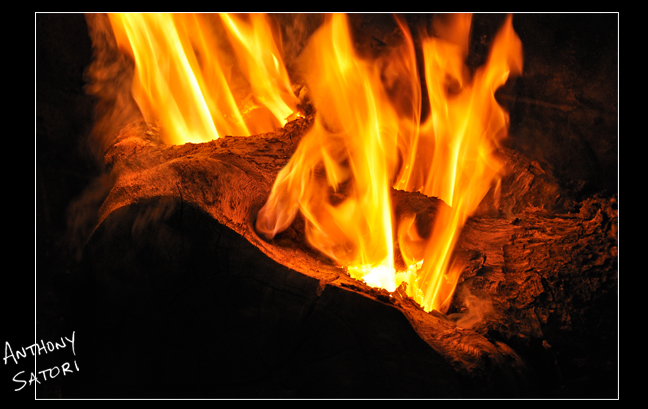
According to Greek mythology, Prometheus stole fire from the gods and gave it to humans for our use and benefit.  It surely must have seemed like nothing less than supernatural forces at play when our ancient ancestors observed lightning crashing down from the heavens and scorching the earth in ways nothing else came even close to doing. Remarkably, opportunistic uses of Prometheus’ gift probably date back more than a  million years, and evidence seems to suggest that the habitual, controlled use of fire probably became part of the human suite of behaviors even as far back as 300,000 to 500,000 years ago, still firmly within the parameters of the Stone Age.  It is truly astounding to fathom that this fundamental element of human experience dates back so amazingly far, and that it still remains part of our lives to this day.  There are very few similarly consistent through-lines in the human experience.

This begins to inform why, even after all of these millennia, sitting around a fire remains nothing less than mesmerizing — watching the movement of the flames, feeling the warming effect of its heat, basking in the soft glow of its light.  And, as anyone who has gone camping or sat around a fireplace will tell you, it is especially pleasurable to share this experience with friends and family.  Whether you are talking, singing, or just listening to the crackle of the fire, this activity feels comforting and natural in a very deep way.  We have been doing this, as a species, for nearly half a million years.  It is surely one of the earliest social rituals of human life. 

There are also other reasons this experience still resonates so deeply with us, even in our modern world of mass media, smart phones and stimulus overload.   All the way back to the earliest era, this activity would have most commonly taken place at the end of the day, so the main work and/or dangers of the day would have been passed.  All of the members of the tribe who had gone out of sight during the daylight hours would be back at the village, now, and accounted for, so there would be a feeling of togetherness and closure.  Also, the fire-side ritual would have happened after dark, which is a mystical time, and a part of the day which would not have been dependably habitable prior to the light and heat provided by the controlled use of fire.  Throughout the night, a fire would have kept predators away from the camp, and so the mere sight of contained flames would have quickly become associated with feelings of security and peace.  The evening fire-side ritual would also almost surely have been accompanied by the smell and flavor of cooked meat, which provided nourishment and a feeling of contentment, a partaking of the spoils of the day.  In addition to all of these things, sitting around the fire would have been the most natural time and place to share and re-live the events of the day through conversation, stories, shared contemplation and even, eventually, song, developing our language skills and strengthening intra-community bonds.  

And so we can see how this simple act of gathering around the fire — this ritual, this experience — is layered with hundreds of thousands of years of human memories of pleasure, security, community and nourishment.  The next time you are sitting around a fire with friends or family, then, take a silent moment to feel just how deeply ingrained this human experience is within your being.  And then kick back, relax, put a steak on the grill, and tell a story from your day.  In this moment, you are truly human.

BlogImage-footd

Polo: The Sport of Kings

“Polo: The Sport of Kings”  |  Anthony Satori

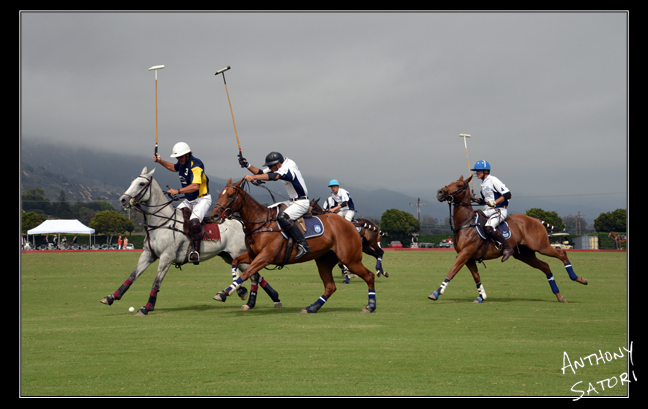
Polo is an impressive spectacle of horsemanship and athleticism that dates back thousands of years.  There are actual cave paintings in China depicting polo matches being played over two millennia ago, and the game has remained remarkably consistent throughout the centuries.  Moving from Asia to Europe and eventually to the New World, polo has often been called the “Sport of Kings,” primarily because of the high cost of maintaining and training large teams of horses, but also for its pomp, ceremony and civility of play.  While still an elaborate production, polo has become far more accessible in the modern era, and now, for little more than the price of a ticket to a baseball or basketball game, anyone who wishes to attend can engage in the fun.  And, after all these centuries, it is still a great experience to enjoy a beautiful day in good company, watching the spectacle play out — the athletes, the “ponies,” the dirt flying — amidst the sunshine, the fresh air, and the smell of freshly-cut grass. 

The only additional element that I might  consider adding would be to have the players do more yelling.  I know, it may sound strange at first, but currently the play is markedly quiet, and I suspect some well-timed battle cries would add an exciting dimension to the event.  Imagine a pack of polo players charging down the field on their horses, mallets in the air, hollering at the top of their lungs!  Can’t you almost hear them?  Aaaaaaugh!  Indeed, I think the occasional hearty group yell would bring an enhanced air of simulated battle to the milieu, and even provide spectators with an opportunity to verbally participate by chiming in.   Of course, if it hasn’t become part of the sport by now, it’s unlikely that they will start doing this any time soon, (certainly not at my suggestion.)  But I figured I’d put the idea on the table.  In the meantime, let’s get out there and stomp some divots, and get ready for the next chukker!

BlogImage-footd