“Simplify. Get rid of all that is unnecessary. Wabi-sabi means treading lightly on the planet and knowing how to appreciate whatever is encountered, no matter how trifling, whenever it is encountered. Wabi-sabi tells us to enjoy the unencumbered life. Obviously, leading the simple wabi-sabi life requires some effort and some will, and also some tough decisions. We still live in a world of things. But wabi-sabi is about the delicate balance between the pleasure we get from things and the pleasure we get from freedom from things.”
“We will be more successful in all of our endeavors if we can let go of the habit of running all the time, and take little pauses to relax and re-center ourselves. And we’ll also have a lot more joy in living.”
“A good traveler has no fixed plans, and is not intent on arriving.”
– Lao Tzu
This is true. A good traveler also knows the direction they wish to go, and they continue to seek ways to keep themselves moving in that direction, each day.
On the one hand, our Good Traveler knows that the journey is the destination, and so they strive to remain present and grateful, each step of the way. On the other hand, they are also mindful and conscious in their choice of the direction they wish to go, and they continue to pursue this good and worthy aim with enthusiasm, clarity, and drive.
“Time unused still vanishes, as if time itself is starving, and each day is swallowed whole, leaving no crumbs.”
– Elisabeth Tova Bailey
Treasure each day. Every moment of life is a gift. Whenever you can, whatever you are doing, strive to look for something to appreciate, to enjoy, to feel wonder about, to be grateful for. Our lives are enriched by the quality of our mindful attention.
“To enjoy good health, to bring true happiness to one’s family, to bring peace to all, one must first discipline and control one’s own mind. If you can control your mind you can find the way to Enlightenment, and all wisdom and virtue will naturally come to you.”
“That’s been one of my mantras – focus and simplicity. Simple can be harder than complex: You have to work hard to get your thinking clean to make it simple. But it’s worth it in the end because once you get there, you can move mountains.”
“Truth cannot be borrowed. It can only be experienced directly. It is the fruit of exploration, suffering, and the direct encounter between one’s own spirit and reality – the reality of the present moment and the reality of ten thousand lifetimes.”
When I consider this statement by Watts, I place it in what I would call the “present eternal” tense. This is, of course, not an actual grammatical tense in any existing language, as far as I know. But for me, it holds a very special place in the lexicon. It is a way to say, “This is true, right now; but it is also true in a manner that transcends the limitations of time and space.” For example, when we tell someone that we love them, from the depth of our heart, I believe that we are speaking in the “present eternal” tense. This is because true Love exists outside of the limits of time and space. Similarly, when God told Moses that His name was, “I AM,” I believe He was indicating that He, in the same way, inhabits this transcendent, eternal realm.
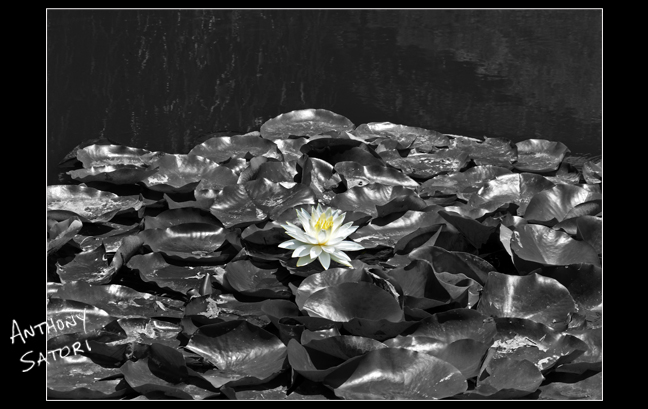
Now, let us consider the sacred lotus. Its roots are sunk deeply into the earth, anchored firmly in the loamy mud at the bottom of a lake, pond, or slow-moving river. The lotus flower derives stability and nourishment from the depth of its roots, and yet its blossom lives far above this stratum, perched weightlessly and elegantly on top of the water. There it lives, peacefully aloft, supported by a bed of leaves, suspended effortlessly above all of the darkness, dirt, and tumult swirling below. When the ground dissolves beneath it, it floats. This is the lotus blossom’s sacred nature, now and always. It was created to live in the sunlight, to transcend the darkness of the water below, just like we are.
The lotus flower also has the rare ability – an ability usually reserved exclusively for animals – to produce its own heat. Consequently, it can regulate its own interior temperature and thereby moderate its own internal state of being in response to, even in direct contrast to, its environment. In addition to this, a dormant lotus seed can remain viable for hundreds of years, with some documented cases of dormant seeds over even 1000 years old re-awakening and successfully flowering. It doesn’t take much to see why this wondrous flower has been a source of fascination and inspiration – as well as a mystical symbol of transcendence and longevity – for artists, poets, and spiritualists alike.
So, the next time you feel stuck in the mud, exhausted by the murky tumult that swirls all around you, remember: you are a sacred lotus. When the ground dissolves beneath you, float. This is your sacred nature, now and always.




 Satori Circle | Art & Culture